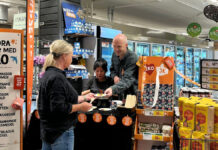


With a strong social commitment, Josefien van Marlen works in the fields of diversity,
inclusion and climate justice from an intersectional perspective. In this context, her
work in the organic sector is marked by her connection to fair trade practices.
She is currently working on two major projects: Nana Bio BV, dedicated to B2B
(Business to Business) trade of organic products under the Demeter biodynamic
farming certification. On the other hand, the creation of BioJong, a network of young
people formally or informally engaged in activities related to organic agriculture, with
the goal of creating synergies to shape the ecological future together and tackle the
problem of generational renewal.
Commitment and determination, basing her actions on the so-called 4Ps: people,
projects, products and politics. At the 2025 European Organic Congress, organized
by IFOAM Organics Europe, she participated in the panel on generational renewal
and youth empowerment in the organic sector, discussing how we can address the lack
of young people throughout the organic value chain. There we had the opportunity to
talk with her about her sectoral work.

What link is there or should there be between organic production and fair trade?
I believe that organic legislation regarding fair trade is not really focusing much on that aspect at the moment, and it is counterproductive. For example, in European legislation, fair trade is explicitly related to fair payment, with equitable remuneration and, in the same direction, the principles of organic farming are ecology, health, fairness and care. So, the link is clear.
Therefore, based on the principle of fairness, one could assume that a fair price should also be part of what is considered organic. But if we look again at the legislation in the European context, we see that this is not necessarily something that is strongly emphasized within the regulations of organic standards.
From that perspective, I believe more could be done within organic legislation to also focus on equity and equality, and integrate it into organic standards. To normalize it further, since it is part of our principles, and so that its European and international reach increases.
What we try to do is really focus on ensuring a fair price for the farmers who work with us. And especially, what we aim to do is to focus more on cooperation rather than competition, particularly in times of climate crisis. For example, some of our farmers, such as those who grow mangoes in India, have to harvest the fruit in temperatures of up to 40°C. So it’s extremely hot for them when picking the fruits. We believe it is essential to ensure decent working conditions, while also ensuring appropriate wages—measures that have real impact.
I believe more could be done within organic legislation to also focus on equity and equality
And how does this relate to consumers?
Meanwhile, here in the West, we talk about unaffordable prices for organic mangoes.
But the question is: are we truly aware of what that implies? Under what conditions are
we asking these people to work, especially with the climate crisis and global warming?
We must be consistent.
We believe it is essential to ensure decent working conditions, while also ensuring fair wages, measures that have a real impact
So, do you work within a climate justice framework?
Yes, it is fundamental. With extreme weather problems around the world, we are
seeing numerous challenges related to this develop. That is why we need to change
the perspective from competition to cooperation.
Author: Gemma Isern Castells, Political Scientist, Master in International Relations, Security and Development
Subscribe to Bio Eco Actual Newsletter and be up to date with the latest news from the Organic Sector
Bio Eco Actual, International Organic Newspaper
Read Bio Eco Actual