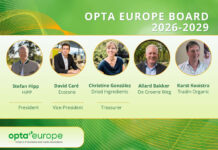


David Caré is Ecotone South Europe General Manager: Biogran, Abafoods & HFS France, the organic and plant-based food group, and President of ASOBIO, the Spanish Association of Organic Processors and Traders. In September, he was elected Vice-President of OPTA Europe, the association representing organic processing and trading companies at European level.

You recently joined the OPTA Europe board. What motivated you to take on this role?
First, it is worth looking at the different associations. We have ASOBIO in Spain, SYNABIO in France and AssoBio in Italy. Aurora Abad, Secretary General at OPTA, has been very proactive in bringing these organisations together so that we have representation in Brussels. The members of ASOBIO in Spain also decided to become part of OPTA.
When you look at the European markets, Spain is probably not the most developed in terms of organic market penetration. However, Spain is a major organic producer. From the perspective of representation and getting everybody on board, it therefore made sense to bring other countries and functions onto the board. Aurora has driven that process very well.
I saw it as a great opportunity for ASOBIO, and also for companies that are not yet members of ASOBIO, to be represented at board level. When Aurora proposed that I become Vice-President of OPTA, it was a very straightforward decision: let’s be active, represent these companies in Brussels and do our best, just as we do with ASOBIO in Spain.
For me, the priority is to ensure that the voice of Spanish organic companies is heard at European level and that we work together to build a stronger, more competitive and accessible organic sector across Europe.
You have worked in the British, French, Italian and Spanish markets. The DACH countries (Germany, Austria and Switzerland) and France play a leading role in Europe’s organic sector. How important is representation from other countries, particularly major organic producers?
Spain is a very good example of why this representation matters. We have a strong organic production base, experienced companies and the capacity to innovate, but we still have significant room to grow in domestic consumption. The challenge is to turn that potential into a stronger market, and European collaboration can play an important role in making that happen
What is great about associations is that you do not necessarily look at a country’s market penetration or the weight of its consumption. You are promoting a different way of producing food, one that we believe is the best way forward for biodiversity, health and future generations.
It is therefore about the willingness to advance an agenda that I believe will be central to what the food industry looks like, or should look like, over the next 20 years.
Whether you are in Italy, Spain, France or the UK, there is a common goal. The Soil Association is doing a fantastic job in the UK, as are SYNABIO and La Maison de la Bio in France, AssoBio in Italy and ASOBIO in Spain. They share that goal regardless of their size, and that is what makes the movement so powerful.
The next step is to ask how effective we can be with consumers. How do we run campaigns that are effective enough to drive consumption? At the same time, how do we explain our position, advocate for it and bring political decision-makers on board for everybody’s benefit? That is a tension we need to resolve, and we need to be good at both.
What should be the main priorities for OPTA Europe and the organic industry?
Starting with consumers, the first priority is making sure they understand what organic means. That includes recognising the Euro-leaf and ensuring that the label is present in people’s minds. We need to explain what is good for them and what is good for the planet and biodiversity, and how organic farming can provide a sustainable way of producing food.
Helping consumers understand this is one of our biggest challenges across Europe. Even where organic market penetration is high, there is still work to do to explain, convince and bring more people in.
We cannot do that alone. Major campaigns from EU Member States are absolutely key. The Generalitat is running a campaign, there are plans for a campaign in Spain, and there are also plans in France and other countries. We absolutely need that support.
A third priority, which has already been agreed at European level, is bringing this into public institutions. How do we ensure that school canteens provide a minimum proportion of organic food for children? That is a fundamental starting point for bringing people in. How do we put it into practice?
There are several fronts we need to tackle, and we need to make sure our associations work as effectively as possible across Europe.
These are shared objectives for the industry. What specific challenges can associations such as OPTA help address, for example in the handling of residues?
Residue handling is a major issue across Europe. You can have a conventional field next to an organic field, and there will always be some risk of cross-contamination through the air. OPTA is working extensively on this, seeking an appropriate level of tolerance so that we do not impose a zero-tolerance approach that would penalise a form of agriculture already doing its best to preserve the soil and the product.
International trade is another major area for OPTA. Europe is a large exporter, but also a large importer. We need to work on this at every level, both in terms of regulation and business.
Labelling is also absolutely key. In innovation and the processing of organic products, we need very clear labelling and sustainability standards that apply across the whole ecosystem, from production to industry and distribution.
Then there is the question of the real price. Coffee provides a good example, because we produce coffee at Ecotone. When people ask whether consumers are willing to pay more during a period of inflation, I turn the question around. The climate is responsible for many of the issues we face, and the way we produce today has an impact on the climate.
The increase in coffee prices over the last two years has nothing to do with being organic and charging more. Because we are not taking the necessary climate measures, coffee yields are being affected. Demand is still there, but supply is lower, so prices rise.
The real question goes beyond whether organic is more expensive. The way we produce today is going to make even conventional products much more expensive. You can see it in coffee and chocolate. You are going to see it in buckwheat grown in France or Spain, where yields are likely to fall. That is not an organic price issue. It is the impact of the climate on the yields of raw materials and commodities around the world.
Consuming organic food can reduce our impact on the climate and, in that way, help address the problem. Fiscal measures, such as the reduced VAT already applied in some countries, or measures to ease the cost of certification, would also help the sector grow. They could make organic food more affordable and available to everybody.
Author: Oriol Urrutia, Editor.
Consider becoming a member of OPTA, the Organic Processing and Trade Association.
Subscribe to Bio Eco Actual Newsletter and be up to date with the latest news from the Organic Sector
Bio Eco Actual, International Organic Trade Media
Read the Bio Eco Actual International Yearbook 2025 – Trends 2026