

The Anabio-Cia national assembly provided an opportunity to launch the debate ‘New Frontiers in Bioprotection in Agriculture: state of the art and prospects for a sustainable future’, which shone a spotlight on this sustainable approach to crop management that is gradually gaining ground, partly in the wake of the ecological transition indicated by the EU and greater environmental awareness and consumer demand for food free of chemical residues. Bioprotection is based primarily on the use of living organisms, natural substances and biological processes to control pests, diseases and abiotic stress.
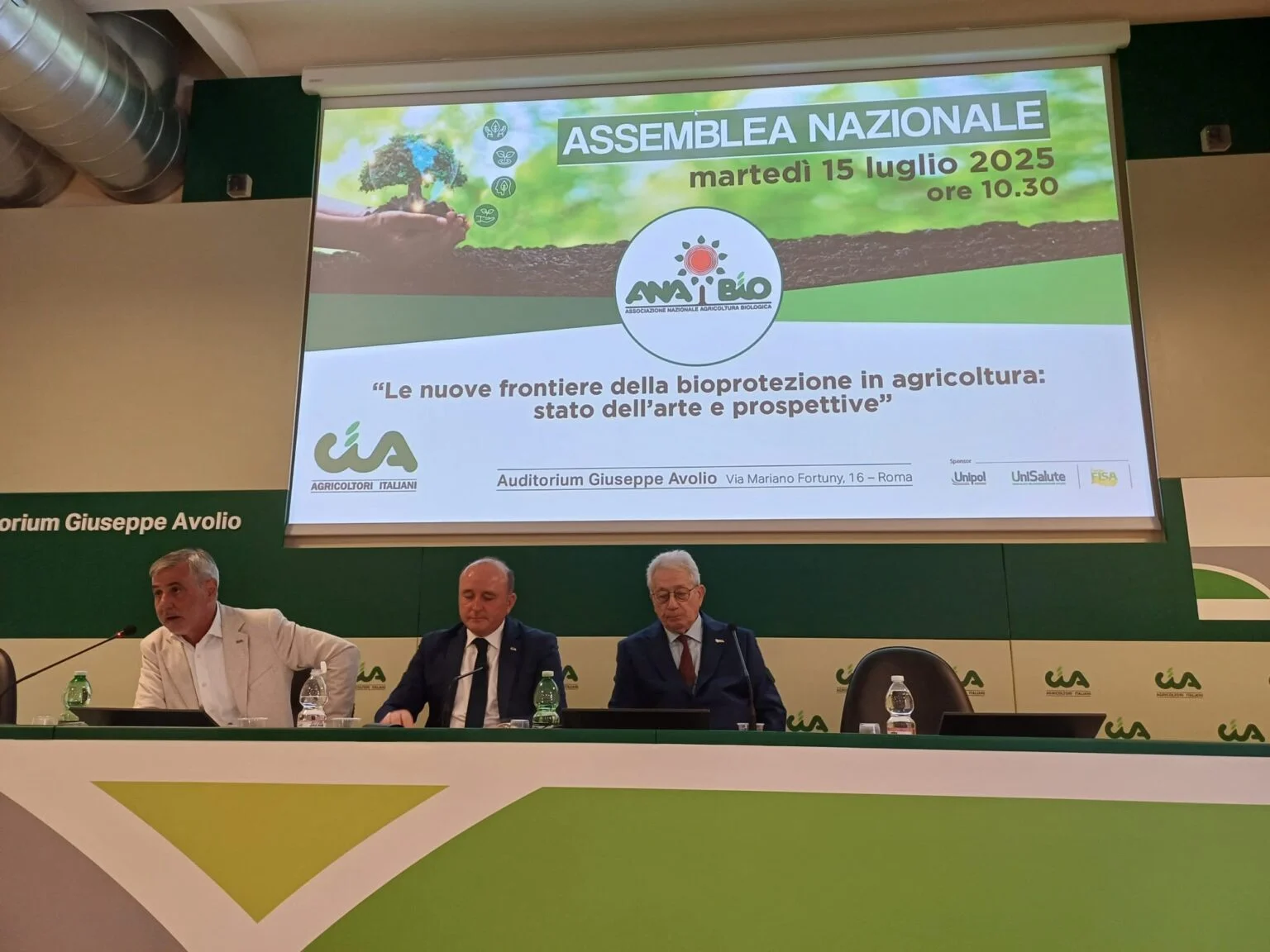
‘A crucial paradigm for modern agriculture,’ observed Anabio-Cia president Giuseppe De Noia as he opened the debate, ‘because it aims to preserve agricultural yields while minimising environmental impact and safeguarding the biosustainability and biodiversity of our territories and production.’ ‘An innovative and integrative strategy that can be used in all stages of plant development,’ added De Noia, ‘and is compatible with organic, integrated and conventional agriculture, leaving no residues on the finished product. Unfortunately, the legislative framework governing bioprotection is complex, and the introduction of biocontrol agents onto the market is hampered by significant regulatory issues.’ These regulatory obstacles were clearly illustrated by representatives of IBMA-International Biocontrol Manufacturers’ Association, the global association of the biocontrol industry, who were present at the conference: the president of IBMA Italy Giacomo De Maio, the technical manager of IBMA Global Jeremy Belzunces and the Regulatory Specialist of IBMA Italy Giovanna Attardi.
The regulatory problems complained about by bioprotection essentially stem from the fact that EU Regulation 1107/2009, which covers technical means of bioprotection, is not focused on biocontrol. Therefore, according to IBMA representatives, it has worked well for standard chemical products but not so well for microorganisms & Co. This shortcoming, Attardi pointed out, was only partially remedied in 2022, with four regulations dedicated to microorganisms. However, as the speakers pointed out, it is not only regulatory constraints that are holding back the use of biocontrol in agriculture. In fact, there are higher costs associated with their use that discourage small farmers, a lack of know-how among agricultural entrepreneurs, as well as partial information and awareness.
Bioprotection is based on the use of living organisms, natural substances and biological processes to control pests, diseases and abiotic stress
According to IBMA Italia, which has been collaborating with CIA for years, working together on the regulatory front to raise awareness among European institutions to define a “fast track” authorisation process for biocontrol agents, it is important to define biocontrol and work together to outline a new dedicated regulation. These proposals have been welcomed by Federbio president Maria Grazia Mammuccini: ‘We are willing to work as a team,’ she said, ‘and support the proposals that have been presented to us, because they are proposals we believe in wholeheartedly.’
The president of CIA-Agricoltori Italiani, Cristiano Fini, also spoke at the conference via videoconference. He is currently in Brussels ahead of the mobilisation to say no to a weakened CAP included in a single fund together with cohesion funds and others. ‘At a difficult time for agriculture,’ Fini observed, “I can, however, give you the good news that I have learned that Agriculture Commissioner Hansen and the entire Commission are interested in the issues of biocontrol. This rewards the pressure to speed up authorisations and give more legs to the issue of biocontrol that we have put in place in recent years, together with the entire organic sector, to achieve a goal that should be realised by the end of the year.”
At the end of the conference, the president of Anabio-CIA, Giuseppe De Noia, the president of Ibma Italia, Giacomo De Maio, the president of Aipp- Italian Association for Plant Protection, Gianfranco Romanazzi, and the president of Federbio, Maria Grazia Mammuccini, signed a document to be presented to the Regions to raise awareness about bioprotection and invite them to provide greater economic and training support for this sustainable crop management system.
The article L’assemblea Anabio-Cia accende i riflettori sulla bioprotezione agricola. Firmato l’appello alle Regioni appeared first on GreenPlanet.

Subscribe to Bio Eco Actual Newsletter and be up to date with the latest news from the Organic Sector
Bio Eco Actual, International Organic Newspaper
Read Bio Eco Actual