
In 2024, organic retail sales in Europe rose to 58.7 billion euros, signalling renewed consumer confidence across key markets. Germany remained Europe’s largest market, while Switzerland stood out with the highest per capita consumption and the highest organic market share worldwide. At the same time, Europe’s organic farming area remained stable.
These latest statistics are published in “The World of Organic Agriculture: Statistics and Emerging Trends 2026”, presented by the Research Institute of Organic Agriculture FiBL and partners at BIOFACH, the world’s leading trade fair for organic food.
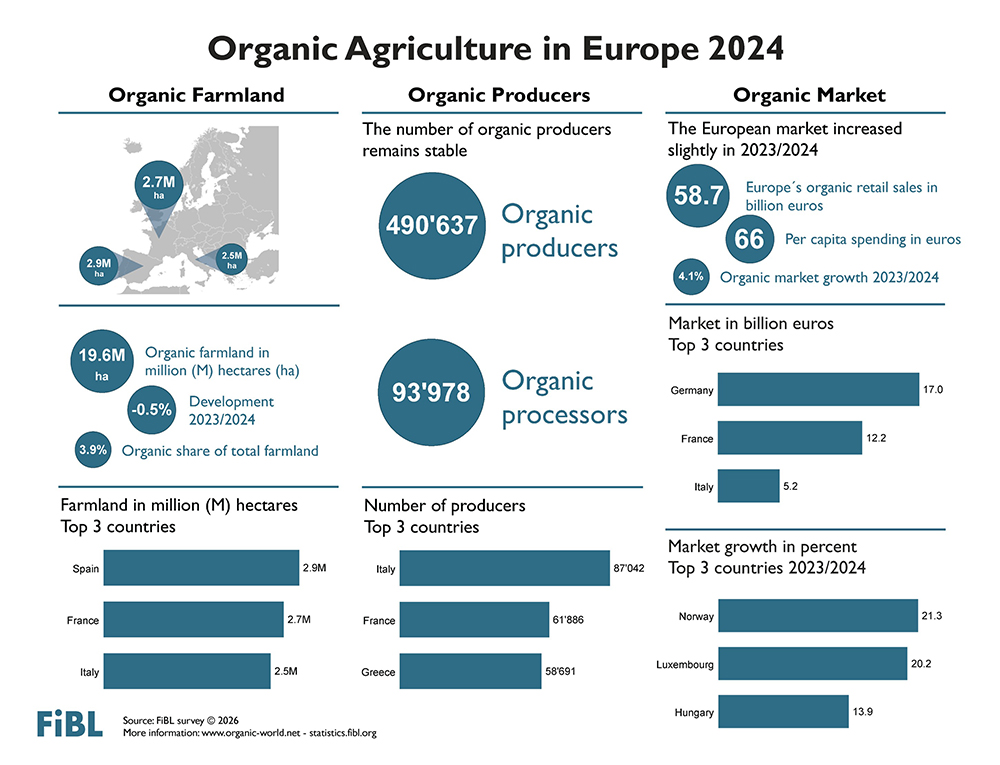
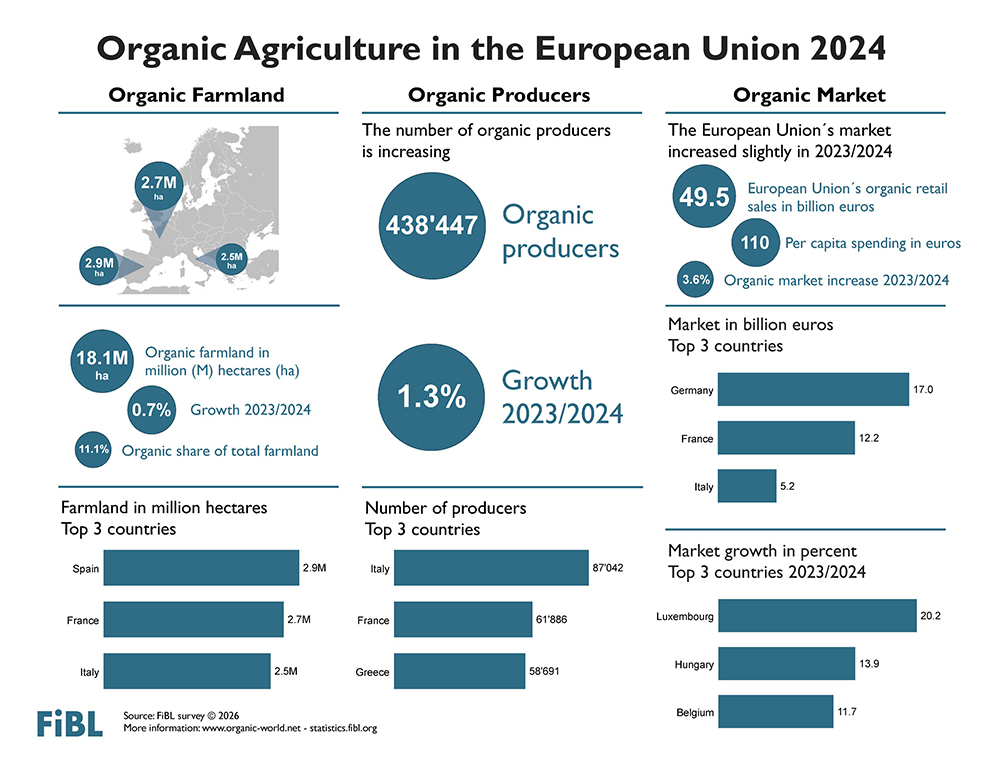
In 2024, Germany remained the largest organic market in Europe (17.0 billion euros), followed by France (12.2 billion euros) and Italy (5.2 billion euros). Europe’s organic retail sales reached 58.7 billion euros (EU: 49.5 billion euros), increasing by 4.1 percent in Europe and 3.6 percent in the European Union. Switzerland recorded the highest per capita consumption worldwide at 481 euros per person and the highest organic market share worldwide at 12.3 percent of total food sales in 2024.
Organic farmland in Europe remained at 19.6 million hectares (EU: 18.1 million hectares), with an organic share of 3.9 percent in Europe and 11.1 percent in the EU. The countries with the largest organic agricultural areas in Europe were Spain (2.9 million hectares), France (2.7 million hectares) and Italy (2.5 million hectares). Liechtenstein continued to have the highest organic land share worldwide (43.5 percent).
International trade strengthened further. In 2024, the EU imported approximately 2.64 million metric tons of organic agri-food products, with the Netherlands, Germany and Belgium the largest importers by volume; Ecuador remained the leading supplier, and tropical fruit – especially bananas – dominated import volumes.
About the publication
The World of Organic Agriculture 2026: Statistics and Emerging Trends is the leading global reference for organic sector data on land area, producers, markets and international trade, compiled by FiBL in cooperation with IFOAM – Organics International and national data partners.
- Further information at www.ifoam.bio and www.fibl.org
Subscribe to Bio Eco Actual Newsletter and be up to date with the latest news from the Organic Sector
Bio Eco Actual, International Organic Newspaper
Read Bio Eco Actual