

The European Patent Office (EPO) significantly restricted a controversial patent on tomatoes with natural resistance to a virus (ToBRFV). The decision is an important partial success for the coalition No Patents on Seeds!, together with about 40 breeding companies and organisations.
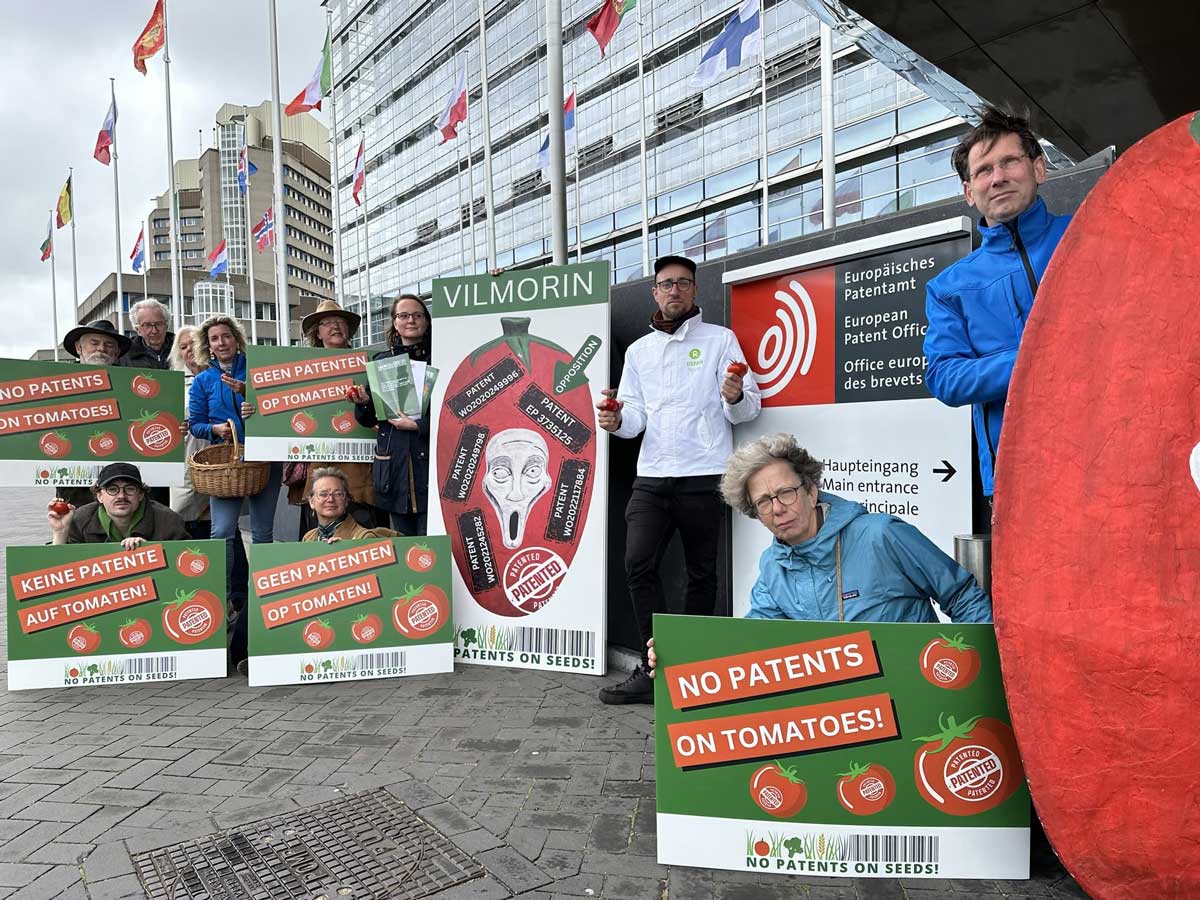
They had filed a joint opposition against patent EP 3629711 held by Vilmorin. Furthermore, both Bayer and BASF also filed oppositions to this patent. In response, Vilmorin withdrew all claims relating to the tomatoes and now only claimed a method for selecting the plants.
Frans Carree from Dutch company De Bolster was involved in the joint opposition and also participated in the hearing. He views the EPO decision as an important success, although it is not a final solution to the underlying problems: “It is important that the patent was significantly restricted. It concerned natural genetic resources, which could also be crucial for our breeding operations. We must preserve the freedom in traditional plant breeding to strengthen diversity and allow small to medium-sized breeding operations to thrive.”
A No Patents on Seeds! report revealed that nine companies had filed more than 20 patent applications targeting conventionally bred tomatoes with resistance to the Tomato Brown Rugose Fruit Virus (ToBRFV). Bayer (Seminis) and BASF (Nunhems) also filed patent applications claiming these tomatoes. Patents on natural traits can block access to the biological resources that are essential for all breeders to develop new varieties.
“In Europe, patents on plant varieties and on conventional breeding are not actually permitted. Only plants derived from genetic engineering can be considered as patentable technical inventions. If patents on conventional breeding are granted, it threatens innovation and diversity in European plant breeding,” says Christoph Then from No Patents on Seeds! who also participated in the hearing.
Today’s ruling limits the scope of a single patent, but No Patents on Seeds! warns that the fundamental problem remains: loopholes in patent law are systematically exploited by companies to expand the boundaries of patentability and thereby gain monopoly rights on natural characteristics of our food plants.
The European Commission has established a new working group to resolve the problems caused by seed patents. Against this background, No Patents on Seeds! is demanding that the member states of the European Patent Office, in conjunction with the European Union, must take steps to close existing loopholes and most importantly clarify the delineation between genetic engineering and the non-patentability of naturally occurring biological resources.
Subscribe to Bio Eco Actual Newsletter and be up to date with the latest news from the Organic Sector
Bio Eco Actual, International Organic Trade Media
Read the Bio Eco Actual International Yearbok 2025 – Trends 2026