

The 27th edition of the yearbook The World of Organic Agriculture has been officially launched by FiBL and IFOAM – Organics International. In 2024, global retail sales of organic food and drink rose to 145.0 billion euros, underlining resilient consumer demand across major markets. At the same time, the global organic farming area remained close to 99 million hectares, providing continuity in the production base. According to the latest figures presented at BIOFACH, the United States remained the world’s largest market, while Switzerland recorded the highest per capita consumption and the highest organic market share worldwide.

These latest statistics of the global organic market are published in The World of Organic Agriculture 2026 and presented by the Research Institute of Organic Agriculture (FiBL) and IFOAM – Organics International on the opening day of BIOFACH, the worlds leading trade fair for organic food, held in Nuremberg, Germany.
Consumers are spending more on organic food and drink across key markets, sending a clear signal to producers, processors, and retailers that demand remains resilient. The global retail sales of organic food and drink rose to 145.0 billion euros in 2024 (increase of 6.9 billion euros). In 2024, the United States remained the largest market (60.4 billion euros), followed by Germany (17 billion euros) and China (15.5 billion euros).
Global retail sales of organic food and drink rose to 145.0 billion euros in 2024, underlining resilient consumer demand across major markets
Switzerland recorded the highest per capita consumption worldwide at 481 euros per person and the highest organic market share globally at 12.3 percent of total food sales in 2024.

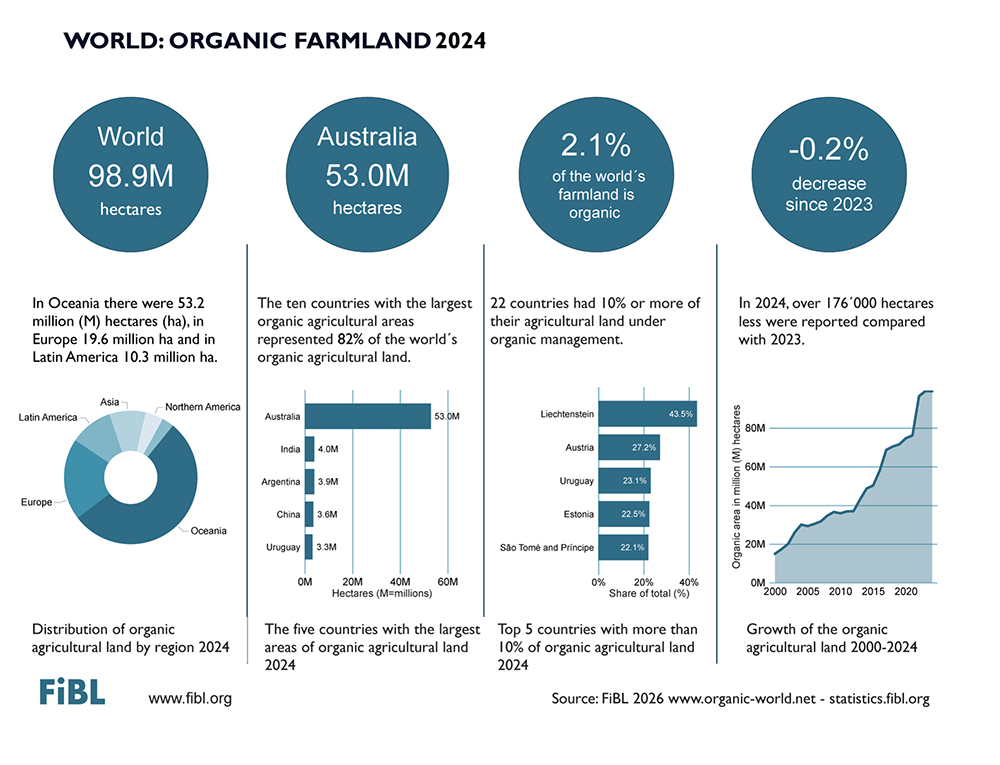
On the production side, organic farmland remained broadly stable at 98.9 million hectares, indicating continuity in the global production base. Australia had the largest organic agricultural area (53.0 million hectares), and Liechtenstein had the highest organic farmland share (43.5 percent).
The number of organic producers reached 4.8 million worldwide
In 2024, combined organic imports into the EU and the United States reached 5.9 million metric tons, reflecting strong market pull and increasingly connected supply chains (up 12.3 percent, by 0.6 million metric tons). The largest exporters to the EU and U.S. markets were Mexico, Ecuador, and Canada.
About the publication
The World of Organic Agriculture 2026: Statistics and Emerging Trends is the leading global reference for organic sector data on land area, producers, markets and international trade, compiled by FiBL in cooperation with IFOAM – Organics International and national data partners.
Publication and data
The yearbook, jointly published by FiBL and IFOAM – Organics International, is supported by the Swiss State Secretariat for Economic Affairs (SECO), the Coop Sustainability Fund, Naturland e.V. and NürnbergMesse, the organiser of Biofach. Data was collected from 183 countries.
- Further information at www.ifoam.bio and www.fibl.org
Subscribe to Bio Eco Actual Newsletter and be up to date with the latest news from the Organic Sector
Bio Eco Actual, International Organic Newspaper
Read Bio Eco Actual