
The EU Regulation 2018/848 is the fundamental framework that guarantees the integrity of organic farming, and its rigorous certification standards are essential. However, some requirements generate excessively burdensome costs for organic producers.

In collaboration with FiBL, IFOAM Organics Europe investigated the specific implications of these costs. Data from the study “Economic impacts of EU Regulation 2018/848 on organic farming” reveal that organic producers face significant costs, mainly in: 1) residue management and prevention; 2) organic quality management staff; and 3) training and capacity building.
On average, operators invest between 5% and 20% of their annual turnover in regulatory compliance costs, with figures varying depending on the segment of the value chain: more than half of traders invest over 10%, farmers up to 23% (with smaller farms recording proportionally higher costs), and processors up to 30%.
Organic producers invest between 5% and 20% of their annual turnover to comply with regulations. But is this always fair?
The research was complemented by six case studies illustrating real-life stories that help convey our message: organic farming is not advocating deregulation, but fair and harmonised regulation that allows the sector to grow. Four case studies focus on residues of naturally occurring substances and the high costs —up to €120,000 for a single investigation— and uncertainty faced by organic companies in proving that they operate ethically.
One case study analyses the costs incurred by control bodies in managing residue investigations, which are often triggered by the strict requirements of the regulation rather than by a genuine risk of fraud. Extensive investigations must be carried out even when the presence of naturally occurring substances has already been identified through previous cases involving the same company and product. These investigations result in only 2% of all investigated cases leading to the loss of organic certification.
Another case focused on small producers. It shows how a turnover threshold disconnected from actual operating costs is driving a growing number of small organic businesses out of certification.
A clear and consistent regulatory approach
The evidence is robust and timely, providing a solid basis for advocacy at European Union level. It is particularly relevant to the report published by the European Commission on the application of Article 29, as well as to the upcoming review of the Organic Action Plan and the Commission’s response to its assessment of Articles 28 and 29.
This research provided the organic sector with data to call for a realistic approach to minor residues and background contamination, including quantifiable investigation thresholds; clearer and more consistent rules across all Member States; and risk-based inspections focused on high-risk producers. Ultimately, the message is that the EU needs a clear and consistent regulatory approach to help the sector grow and remain competitive.
The EU needs a clear and consistent regulatory approach to help the sector grow and remain competitive
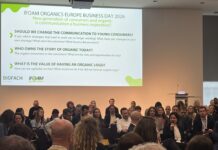
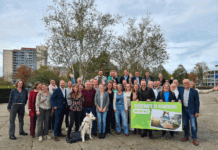
On 24 June 2026, these messages were delivered directly to Christophe Hansen, Commissioner for Agriculture and Food, who visited the Organic House of Agriculture during the IFOAM Organics Europe General Assembly.
A representative from the Quality Department of Agriwell S.A., a company trading organic products, shared the case of a batch of organic products that was under investigation for approximately 11 months. The investigation cost the company around €15,000. Although it was eventually confirmed that the batch was organic, the decision came too late: by the time the investigation concluded, the products had deteriorated, forcing the company to fumigate them and sell them as non-organic.
The question was: if everyone agrees that a product is organic, but the process itself destroys its organic value, how can we expect operators to continue investing in the growth of the sector?
These kinds of stories are very useful for conveying important requests and are compiled in a series of case studies available to IFOAM Organics Europe and other interested parties upon request.
Author: Clara Garrone, Senior Expert in Projects and Partnerships at IFOAM Organics Europe.
Subscribe to Bio Eco Actual Newsletter and be up to date with the latest news from the Organic Sector
Bio Eco Actual, International Organic Trade Media
Read the Bio Eco Actual International Yearbok 2025 – Trends 2026