
Organic certification in the European Union verifies that farmers, processors and other operators follow the rules established for organic production, labelling, traceability and control. It turns the word “organic” into a regulated claim rather than a general statement about how a product was made.
For consumers, the most visible sign of this system is the green EU organic logo, the Euroleaf. Behind it, however, there are registered operators, documentary checks, inspections, product records and controls throughout the supply chain. This guide explains who needs certification, how the process works and what information should appear on certified organic food.
What organic certification means in the EU
Organic production in the European Union is governed principally by Regulation (EU) 2018/848. It establishes rules for agricultural production, livestock farming, aquaculture, processing, distribution, imports, controls and the use of organic claims.
Certification confirms that an operator and the products covered by its certificate comply with the applicable organic rules. Depending on the activity, these rules address matters such as soil fertility, crop rotation, animal welfare, organic feed, permitted inputs, separation from non-organic products, traceability and record keeping.
The system restricts the substances and techniques that can be used, but it should not be reduced to claims such as “chemical-free farming”. Only authorised products and substances may be used for specific purposes, while genetically modified organisms are prohibited in organic production.
Certification does not establish that a food is automatically more nutritious, completely free from residues or sustainable in every possible respect. It verifies compliance with a defined production and control system.
Who needs organic certification?
As a general rule, businesses must enter the organic control system before placing products on the market using terms such as “organic”, “bio” or “eco”. The requirement can apply to different participants in the supply chain, including:
- Farmers, livestock producers and aquaculture operators.
- Food processors and manufacturers.
- Businesses that package or relabel organic products.
- Distributors and storage operators.
- Importers and exporters.
- Companies that place products on the market under an organic claim.
The precise obligations depend on the activity and on how the product is handled. EU legislation provides certain exemptions for retailers that sell prepacked organic products directly to final consumers, provided that they do not produce, prepare, import, subcontract or store those products away from the point of sale.
Member States may also establish limited exemptions for some direct sales of unpackaged organic products. A company should therefore confirm its position with the competent national authority or an authorised control body before using an organic claim.
How the certification process works
The details vary between countries and types of production, but the usual certification process follows these steps:
- Define the activities and products covered. The operator identifies which farms, facilities, processes and product categories will form part of the organic operation.
- Notify the competent authority. Before marketing products as organic or in conversion, the operator registers its activity through the system established in the relevant Member State.
- Choose an authorised control body when required. This organisation evaluates compliance and carries out the corresponding controls.
- Prepare the required procedures and records. These can include information about suppliers, ingredients, production methods, cleaning, storage, product flows and measures to prevent mixing or contamination.
- Complete the initial verification. The control authority or body examines the operation, its documentation and the facilities or production units concerned.
- Correct any non-compliance. If deficiencies are found, the operator may have to provide evidence of corrective action before certification can be granted.
- Receive the organic certificate. The certificate identifies the operator, the activities and product categories covered and its period of validity.
- Maintain compliance. Certification requires ongoing records, controls and notification of relevant changes to the certified operation.
Farmers converting land or animals from conventional to organic production must also respect the applicable conversion period. Its duration and conditions depend on the type of production. Products cannot be presented as fully organic before the relevant requirements have been met.
Inspections, risk-based checks and non-compliance
Organic controls combine documentary verification, traceability checks and physical inspections. Operators covered by the control system are normally subject to verification at least once a year.
The frequency and intensity of controls also depend on risk. Authorities and control bodies can consider the size and structure of the operation, its products, previous compliance, the risk of mixing organic and non-organic goods, the use of subcontractors and other factors that could affect the integrity of the product.
For operators assessed as low risk, the period between physical on-site inspections may be extended under specific conditions. This is only possible after a record of compliance and cannot result in a period of more than 24 months between physical inspections.
The control system also includes additional checks, a proportion of unannounced inspections and product or material sampling where necessary. Records must make it possible to trace incoming ingredients and products, follow their movement through the operation and compare the quantities purchased, produced, stored and sold.
When a breach is detected, the consequences depend on its nature and severity. They can include corrective measures, restrictions on particular batches, suspension or withdrawal of certification and a prohibition on marketing the affected products as organic.
How to read the EU organic logo and control-body code
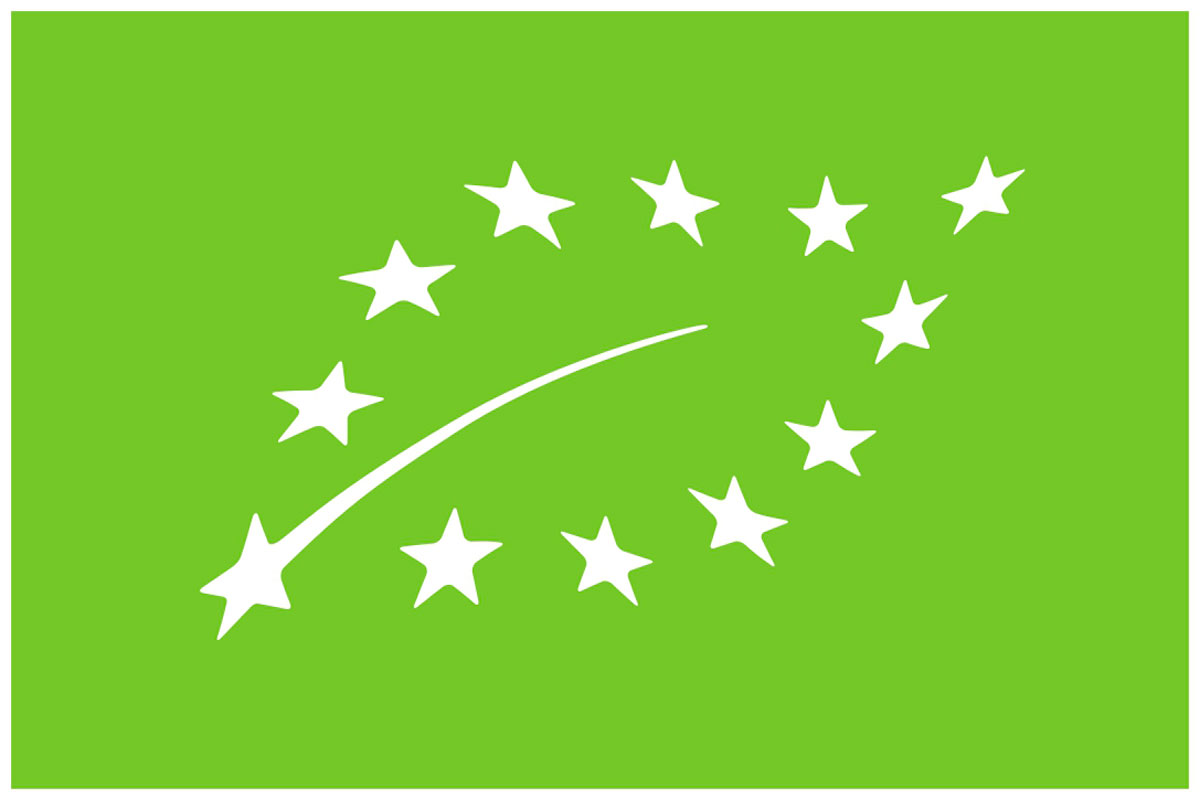
The EU organic logo consists of a white leaf formed by stars on a green background. Its use indicates that the product has been certified and meets the conditions established by European organic legislation.
For prepacked organic food produced and sold within the European Union, use of the logo is compulsory. In processed foods, at least 95% of the agricultural ingredients by weight must be organic for the product to be presented and labelled as organic. The remaining agricultural ingredients must comply with the conditions established by the rules.
The following information must appear alongside the logo:
- The code of the control authority or control body responsible for controlling the operator that carried out the last production or preparation operation.
- An indication of the origin of the agricultural raw materials, such as “EU Agriculture”, “non-EU Agriculture” or “EU/non-EU Agriculture”. A country or regional indication may be used when the applicable conditions are met.
Control-body codes begin with the identifier of the country and include a term associated with organic production, followed by the reference assigned to the body. Their exact format varies between national systems.
The logo is optional for certain compliant imported products and for non-prepacked organic products. It cannot be used for products containing less than 95% organic agricultural ingredients, products still marketed as being in conversion or goods outside the scope of EU organic food rules, such as cosmetics.
National, regional and private labels can appear alongside the European logo. These may communicate additional standards or commitments, but they do not replace the legal requirements of EU organic certification. Our article on the future of organic labelling examines how the growing number of environmental and regenerative labels can also make consumer understanding more difficult.
Certification and imports into the European Union
Organic products imported into the European Union must comply with the rules governing organic trade and be covered by the appropriate controls. The importer, exporter and relevant control bodies must be correctly identified, and the products need the documentation required for their entry into the European market.
An electronic certificate of inspection is required for organic consignments imported into the EU. This certificate is managed through the European Commission’s Trade Control and Expert System, known as TRACES. Without a valid certificate, the consignment cannot be released in the European Union as organic.
Import controls are intended to preserve traceability from the operator in the country of origin to the first consignee in the EU. Importers must therefore verify the documentation, the identity of the consignment and any conditions attached to its certification before marketing it as organic.
Frequently asked questions about organic certification
Is “natural” the same as organic?
No. “Organic” is a regulated production and labelling claim within the European Union. The word “natural” does not by itself demonstrate that a food has been produced under the EU organic rules or independently certified.
Does the EU organic logo mean every ingredient is organic?
Not necessarily. A processed food bearing the logo must contain at least 95% organic agricultural ingredients by weight. The remaining agricultural ingredients are only permitted under the conditions established by organic legislation. Water and salt are not included in this percentage calculation.
Is the EU organic logo always compulsory?
It is compulsory for prepacked organic food produced and sold within the EU. Its use is optional in some other circumstances, including certain imported or non-prepacked products. The absence of the logo should therefore be assessed together with the organic claim, control-body code and circumstances in which the product is sold.
Can restaurants use the EU organic logo?
The European organic logo cannot be used to identify mass-catering operations such as restaurants, canteens or hospitals under the general EU logo rules. National or regional schemes may establish specific requirements for organic catering claims.
How can a company check an organic supplier?
Before buying or selling a product as organic, a business should check that the supplier holds a valid certificate covering the relevant operator, activity and product category. The invoice, delivery documentation, product label and control-body information should be consistent and retained as part of the traceability records.
Does certification guarantee that a product is sustainable in every respect?
No single certification measures every environmental or social aspect of a product. EU organic certification covers a specific set of farming, processing, animal welfare, input, traceability and labelling requirements. Factors such as transport, packaging, water use, labour conditions and the overall climate impact may require additional information or assessment.
A common system based on control and traceability
Organic certification provides common rules for operators and consumers across the European market. Its credibility depends on documented practices, traceable product flows, independent controls and appropriate action when requirements are not met.
Consumers can identify certified food by checking the organic claim, the European logo where applicable, the control-body code and the indication of agricultural origin. Businesses, meanwhile, should verify that their own certificate and those of their suppliers cover the products and activities involved.
As the legislation and its implementation continue to evolve, operators should confirm specific requirements with their competent authority or control body. Further developments can be followed in our Organic Policy & Regulation section.
Subscribe to the Bio Eco Actual newsletter and stay up to date with the latest news from the organic sector.
Bio Eco Actual, International Organic Trade Media