

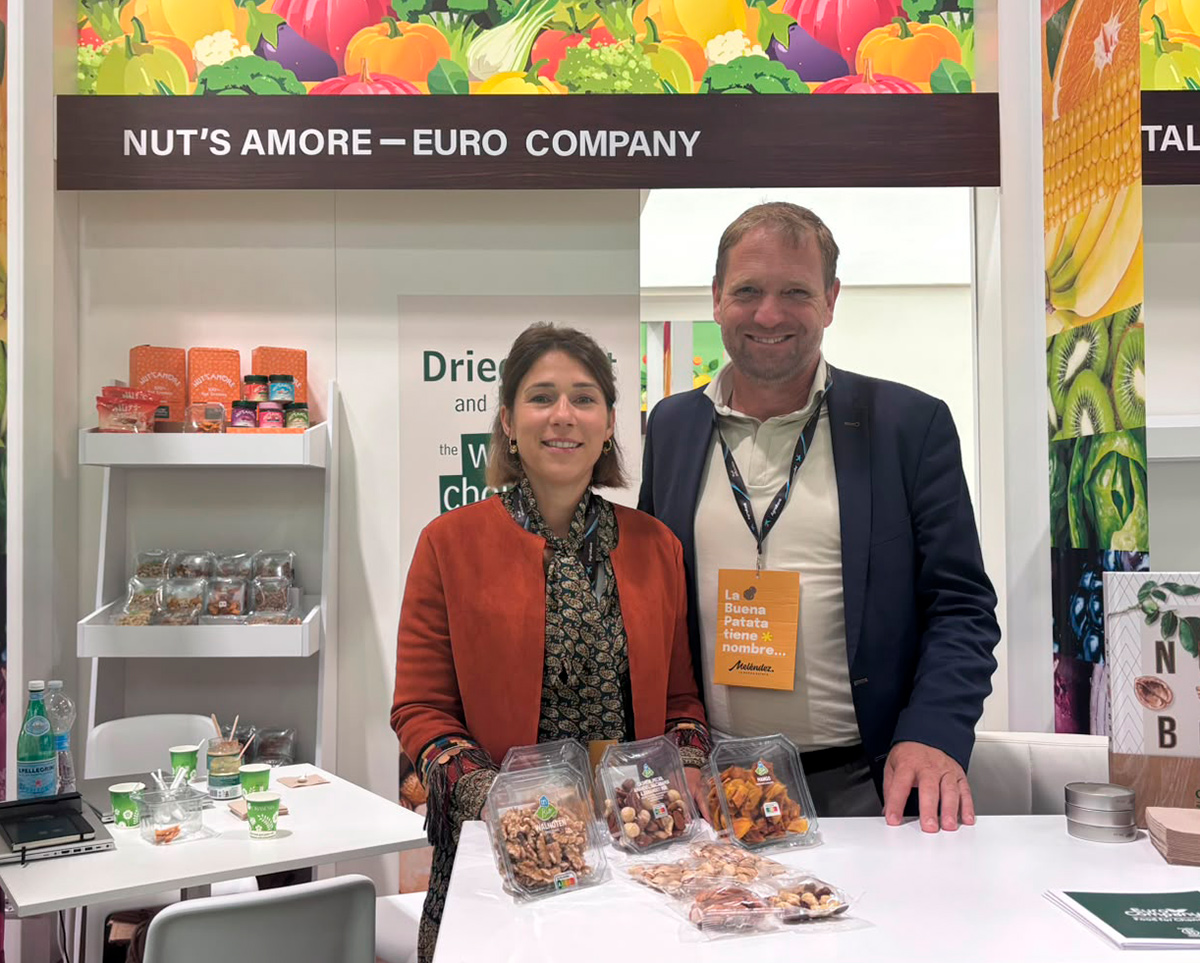
What principles guide Euro Company?
Our vision is Food for Change. We want to be a reference point for healthy and sustainable nutrition and have a positive influence on the wider food industry. Alongside turnover, we focus on health and respect for the planet and people.
Sustainability and ethics are pillars of the company. We are a Società Benefit and dedicate resources to social initiatives. Our sustainability report sets out the projects and activities we carry out.
Where is your organic range available in specialist retail?
Econoce is our organic brand. We work with specialist retailers: NaturaSì is one of our main customers in Italy, and we also supply Bio-Planet in Belgium and Veritas in Spain, as well as small Italian retailers.
How do you approach partnerships with retailers and private label?
We want to work with retailers to develop the nuts and dried fruit category. Over the years, we have developed different concepts to encourage shoppers to try products, support impulse purchases and improve the shopping experience.
We work with both our own brands and private label. Our conventional brand is Nut’s Amore. Econoce also includes formats for impulse purchases. The concepts we are presenting at the fair can be adapted to both conventional and organic products.
One of the formats you are presenting has a €0.99 price point. What have you learned from this model?
It was one of our first successful concepts in Italy. The displays are placed in the fruit and vegetable department, with three ranges: blue for snacking, red for aperitifs and green for cooking.
It is a practical, accessible format that encourages trial and product turnover. Several Italian chains have adopted it.
What does transparent packaging bring to organic nuts?
Transparency allows consumers to see the product, assess its quality and know what they are buying. It also creates a visual connection with the fruit and vegetable department, giving nuts and dried fruit greater visibility in that setting.
One example is the range of eight organic products we developed for Albert Heijn, positioned in its healthy snacking section.
We also work with this type of presentation in Italy, for example with Esselunga. Our experience in the Italian market has enabled us to develop models that we can then adapt to other countries.
What are the features of this packaging in terms of materials and use?
The transparent tray is made with 90% recycled plastic and is 100% recyclable. The format can also be opened and resealed, making it convenient to use.
What is your approach to dried fruit in doypack pouches?
Doypacks are already a familiar format for nuts. We also want to promote high-quality dried fruit, including mango, pineapple and coconut.
The pouch is resealable, 100% recyclable and has a strong shelf presence.
How do you adapt your concepts to other markets?
Italy remains our main market, but we are also growing in other countries. We have developed variations of our concepts for other markets, including Norway with Bama, in 100g and 200g formats.
What criteria do you use to select suppliers?
We work with carefully selected partners committed to sustainable and ethical farming practices, in line with our company values. Our dried fruit partners include two companies in Africa.
Another example is a macadamia product we supply to Colruyt, with a sustainable supply chain project behind it.
What trends are you seeing in dried fruit?
Mango is a trend that is growing very quickly. We offer it in different formats, including strips and chunks. During our store visits in Spain, we have also seen that Dia and Alcampo have introduced dried fruit in doypacks.
What role can this category play in eating habits?
We want to encourage eating habits that include nuts and dried fruit. Their consumption is well established in Italy and Spain, but we believe it still needs more support in other markets, including northern Europe, the UK and Germany.
The presentation of the products and their visual connection with fresh fruit and vegetables can help encourage that consumption.
Where do you see opportunities to develop these concepts in Spain?
Spain is also a demanding market. During our store visits, we have seen little presence of nuts and dried fruit in the fruit and vegetable department. That is why we want to promote concepts here that are already working in Italy and other markets.
For a range such as the one at Albert Heijn, we see potential in supermarkets with a more premium positioning. In the Netherlands, the category grew in the fruit and vegetable department from products such as peanuts in their shells and in-shell walnuts, before the assortment expanded.
Author: Oriol Urrutia, Co-Editor and Political Scientist
Subscribe to Bio Eco Actual Newsletter and be up to date with the latest news from the Organic Sector
Bio Eco Actual, International Organic Trade Media
Read the Bio Eco Actual International Yearbook 2025 – Trends 2026