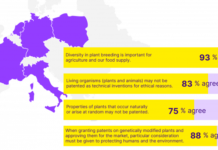


European law says that only genetic modification can be regarded as a patentable invention in plant breeding. Nevertheless, there are already 200 patents on traditional breeding since loopholes in patent law are misused by big seed companies.
Breeders need access to genetical material so that they can adapt plants to new pests and diseases or changing climate conditions. The current legal uncertainty within the European patent system severely hinders the work of breeders. Many refrain from working on a specific trait, because they can’t take the risk of infringing a patent of a big company.
To give an example, several companies such as BASF, Bayer or Rijk Zwann filed over a dozen patents on a resistance against the Tomato Brown Rugose Fruit Virus (TOBRFV), also known as Jordan virus – even though they only used traditional breeding which, following European patent law, can not be patented. This means that other breeders will be discouraged by the immense legal uncertainty.
The companies are claiming various genomic regions. All tomato plants inheriting the genetic variations generated through whatever kind of breeding are claimed as an invention, even though they occur naturally and are found in wild species of tomatoes. Conventional breeders aiming to produce tomato varieties with a resistance to the virus will, in many cases, not know the exact genotype of their plants. Therefore, to avoid patent infringement, they would have to analyze around a dozen patent applications and screen for all genetic variants described in the patent. In addition, they may have to enter into about a dozen license contracts. With such impediments, many breeders will simply come to the conclusion that they cannot breed those particular tomatoes without incurring fees for expensive patent attorneys or comprehensive laboratory analyses. This effectively blocks access to the biological material needed in traditional breeding to generate the desired virus resistance. Consequently, the legal uncertainty and the threat of expensive legal battles are likely to prevent breeders from generating urgently needed tomato varieties.
Patents like the ones granted on tomatoes pose a serious threat to diversity in plant breeding. This would have a devasting effect on food security in Europe. Political action is needed by the 39 member states of the European Patent Office and by the EU to ensure the correct interpretation of European patent laws.
Support our campaign: www.no-patents-onseeds.org/en/campaign

Subscribe to Bio Eco Actual Newsletter and be up to date with the latest news from the Organic Sector
Bio Eco Actual, International Organic Newspaper
Read Bio Eco Actual