

Getting more varieties of organic products into mass retail outlets is certainly a good strategy to relaunch the sector, and there is a commitment to this on the part of the large retail chains, but among consumers there is still little knowledge, if not confusion, about the characteristics and values of organic products. This is why, in order to relaunch organic products, it is necessary to start from the point ‘that the distribution strategy is not only made by large-scale retailers but by the entire sector,’ as Coop’s Head of Development and Sustainability G.Bellini and the columnist Fabrizio Piva emphasised. This is the summary consideration that emerged from the webinar ‘Distribution, a role to recover’, the second appointment of the cycle ‘How organic can become a protagonist again’ organised by GreenPlanet in collaboration with Omnibus Comunicazione and the support of Consorzio il Biologico.

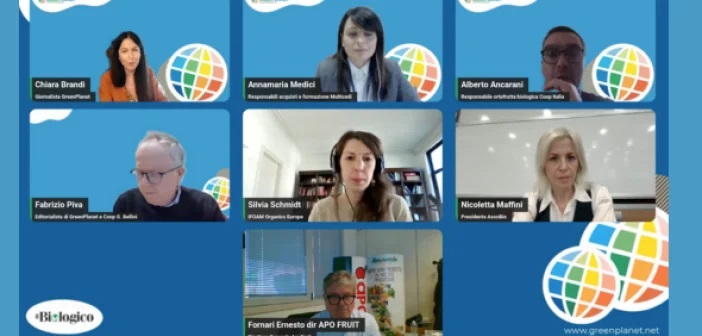
The meeting, moderated by Chiara Brandi, journalist co-ordinator of GreenPlanet, as well as the participation of Fabrizio Piva, saw speeches by Alberto Ancarani, head of organic fruit and vegetables at Coop Italia, Nicoletta Maffini, president of Assobio, Ernesto Fornari, director of Apofruit, Silvia Schmidt, policy manager IFOAM Organics Europe and Annamaria Medici, head of fruit and vegetable purchasing and training at Multicedi.
From the interventions of the fruit and vegetable managers of Coop Italia and Multicedi it emerged that neither the wide assortment nor promotional flyers helped to foster organic consumption in their shops. ‘We have tried to relaunch organic consumption and, despite the wide assortment we offer, we have not had the expected results, the recipe has not yet been found,’ emphasised Alberto Ancarani regarding organic sales at Coop Italia.
‘In the Multicedi shops,’ Annamaria Medici remarked for her part, ‘it is difficult to sustain the organic assortment. Categories such as nickel free and zero residue have eroded organic sales a bit and we had also given up a bit, but then we decided to please the consumer who is looking for it and so we resumed including it in our promotional flyers, also providing information to strengthen consumer confidence and build consumer loyalty’.
Among consumers there is still little knowledge, if not confusion, about the characteristics and values of organic products
For Nicoletta Maffini, president of Assobio, the organic consumption market is showing a bit of a recovery and is still above the 3% share of the total agri-food industry commonly indicated, because the consumer does not only buy in large-scale distribution but also in direct sales outlets and specialised shops. ‘Having said that,’ Maffini noted, ‘there is still a lot to be done and it can be done together, between the various operators in the supply chain. For our part, we work a lot in synergy with the large-scale retail trade to promote and, if the expected results have not yet been achieved, it is because there is still mistrust of organic products on the part of the consumer, who is also confused by the various green claims’.
On the consideration recently expressed by Minister Lollobrigida that organic farming should increase production and guarantee the market lower prices within the reach of a wide consumer public, Apofruit Director Ernesto Fornari intervened, observing that ‘in this way we are shooting ourselves in the foot. In fact,’ said Fornari, “my fear, most of all, is that without the right income for organic producers, agricultural land will be lost, and when an organic farm is lost, you will never get it back”. ‘More information needs to be provided to consumers and an assorted product range with many varieties needs to be offered,’ Fornari added, ’as well as seasonal promotion campaigns at the right time.
Coop Italia wanted to contribute a solution to the problem of relaunching organic products by noting that ‘we can think of pushing more on certain types of organic products that consumers like, such as lemons,’ said Ancarani, ‘by putting only organic lemons on sale in small and medium-sized supermarkets and not conventional ones. A proposal defined as ‘interesting’ by the director of Apofruit, Fornari, ‘because different sales sizes can offer different sales options. We have had experience in this sense, with positive results’. However, Annamaria Medici expressed reservations about the ‘one-way sales’, emphasising ‘that she does not agree with the idea of eliminating the conventional product because our sales reality (Multicedi is a leading retail reality in central-southern Italy, mainly in Campania, ed.) is in a highly productive territory’. Medici reiterated that consumers need more information on the organic product ‘and if the zero residue has increased sales, it means that it has been able to communicate better than organic’.
Certainly organic ‘has values and characteristics that other production systems do not have and that should be better communicated,’ Fabrizio Piva remarked. ‘For example, we should push the communication of the environmental premium of organic farming.
Silvia Schmidt of IFOAM Organics Europe, the European division of Ifoam Organics International, the international federation of organic farming movements, addressed the issue of tariffs, reporting that the federation ‘immediately contacted its US counterpart, and associations in the agricultural sector have expressed concern on both sides of the ocean. There is a widespread belief that the introduction of tariffs will have negative effects for both producers and consumers‘.
The article Organic in Italy: rebuilding trust and revising distribution strategies appeared first on GreenPlanet.

Subscribe to Bio Eco Actual Newsletter and be up to date with the latest news from the Organic Sector
Bio Eco Actual, International Organic Newspaper
Read Bio Eco Actual