

The French Competition Authority has imposed a €12.67 million fine on Synadis Bio, Greenweez (Carrefour), Intermarché (ITM Entreprises) and Les Comptoirs de la Bio for participating in an agreement aimed at separating organic suppliers’ brands between mainstream retail and the specialised channel, limiting competition between the two.

According to the Autorité de la Concurrence, this was a “single, complex and continuous” agreement whose aim was to prevent the same organic product brands from being present at the same time in the specialised channel and in mainstream food retail. The regulator argues that this strategy sought to avoid the comparability of products and prices between the two channels, in a context in which mainstream retail had become, since 2016, the leading sales channel for organic products in France.
The amounts of the fines
- Synadis Bio: €10 million
- Greenweez (jointly and severally with Carrefour SA): €1.85 million
- Intermarché (ITM Entreprises jointly and severally with Les Mousquetaires): €740,000
- Les Comptoirs de la Bio: €80,000
The largest fine was imposed on Synadis Bio, the French trade association of specialised organic product distributors. The authority considers that, through meetings of its board of directors and internal rules adopted in 2018, it promoted a collective strategy aimed at preventing the sale of the same organic product brands in both channels.
What the authority says
The official statement places the origin of these practices in the increase in competition between mainstream retail and the specialised channel between 2016 and 2020. During that period, mainstream retail gained weight in the organic market, while the specialised channel lost market share.
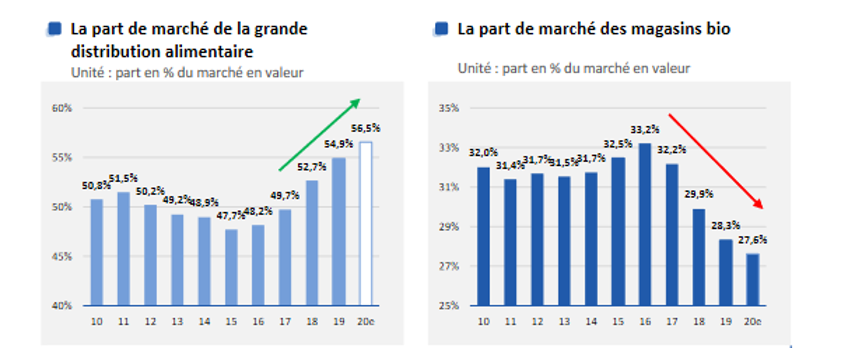
Evolution of the organic market in France and distribution by channels (mainstream retail vs specialised channel). Source: Autorité de la Concurrence / Xerfi.
The origin of these practices dates back to 2017. According to the authority, at that time Synadis Bio’s board of directors reacted to the sale of organic products from the Bio c’Bon chain through Amazon, a situation it considered especially sensitive for the specialised channel.
“This represents a new and worrying competing activity for specialised organic stores because it blurs the boundaries between distribution channels and encourages price comparability,” Synadis Bio’s board said in its deliberations, according to the documentation cited by the competition authority.
From that point on, the organisation promoted agreements with different operators to keep brands separated across the different distribution channels.
In that context, Synadis Bio held internal discussions to reinforce brand differentiation between channels and preserve the price positioning of the specialised channel. The competition authority cites, among other elements, meeting minutes and the organisation’s internal rules.
In December 2018, Synadis Bio included the principle of brand segmentation by channel in its internal rules. Specifically, Article 2 required its members to market at least 95% of packaged organic food products distributed exclusively in specialised organic stores.
The authority also considers the active participation of Greenweez (Carrefour), Les Comptoirs de la Bio and Intermarché (ITM Entreprises) to be established. According to the official statement, during the exchanges held while reviewing their applications to join Synadis Bio, these companies expressed their commitment to the rules and practices of the specialised organic sector.
In the case of Greenweez, the Autorité states that the company confirmed its willingness to ensure there would be no “mix of brands and ranges” and to align itself with the “unwritten rules” of the specialised channel model. In the case of Intermarché and Les Comptoirs de la Bio, the authority refers to discussions on maintaining a strict separation between specialised and mainstream networks, excluding the coexistence of brands across both channels.
A market in transformation
The competition authority itself places the case within the evolution of the French organic market. Between 2010 and 2020, organic food consumption in France rose from €3.7 billion to €13.2 billion. At the same time, the specialised channel’s market share remained around 32% to 33% until 2016-2017, but declined from 2018 onwards and fell below 28% in 2020. By contrast, mainstream retail’s market share exceeded 56% in 2020.
The official statement also highlights the growing convergence between mainstream and specialised retail. Carrefour acquired Greenweez in 2016, So.Bio in 2019 and Bio c’Bon in 2020. For its part, Les Mousquetaires gradually took a stake in Les Comptoirs de la Bio from 2018 onwards.
What happens now
In addition to the financial penalties, the Autorité de la Concurrence has ordered Synadis Bio to amend the challenged provisions of its internal rules and publish a summary of the decision in a trade magazine. The companies involved may appeal the ruling.
The case once again brings a structural issue to the table for the sector: the competitive pressure between the specialised channel and mainstream retail. The French ruling sets a clear limit on defending a distribution model through agreements that affect free competition.
Source: Autorité de la Concurrence: https://www.autoritedelaconcurrence.fr/en/press-release/autorite-de-la-concurrence-fines-syndicat-national-des-distributeurs-specialises-de
Subscribe to Bio Eco Actual Newsletter and be up to date with the latest news from the Organic Sector
Bio Eco Actual, International Organic Newspaper
Read the Bio Eco Actual International Yearbok 2025 – Trends 2026