

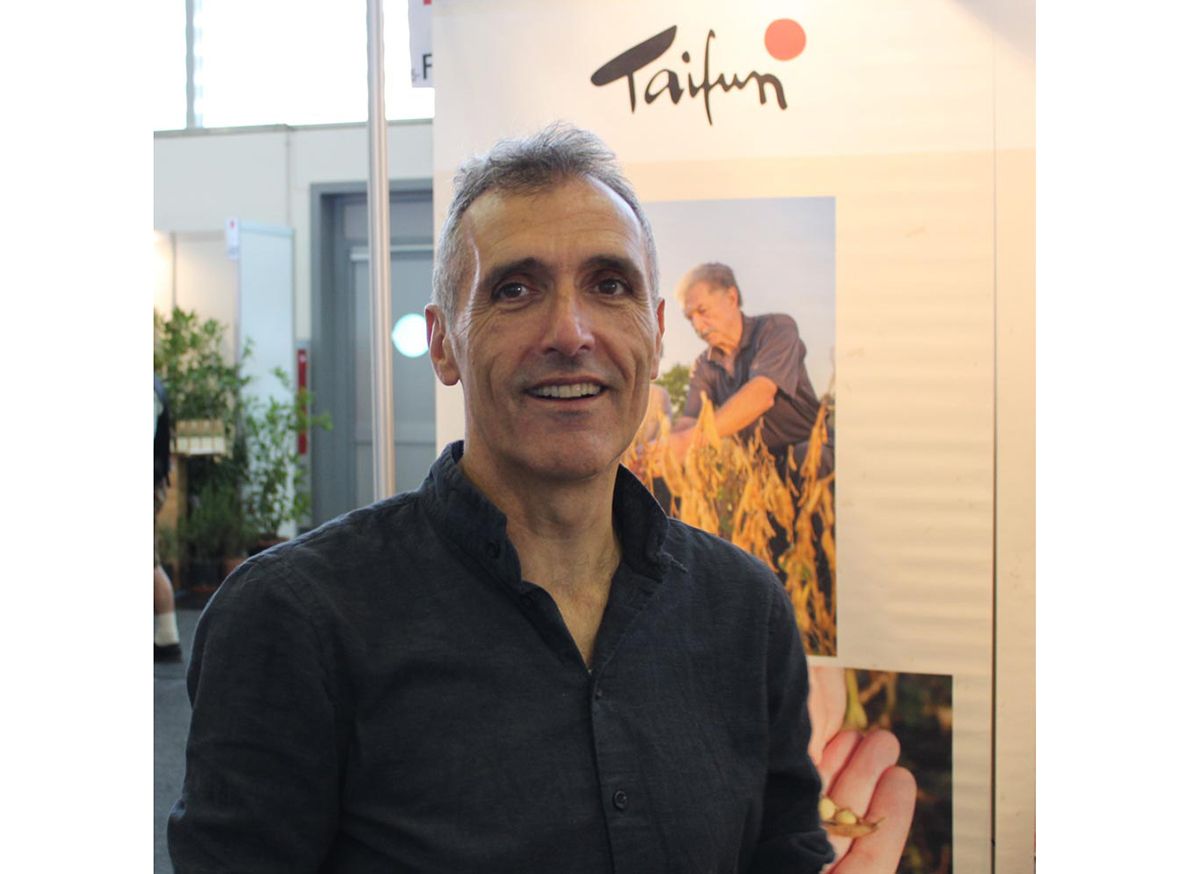
Jesús Bastante is a professional who is convinced about food and the organic world. With a degree in classical philology, for 20 years he has been part of Taifun, a leading company in Europe in the production of organic tofu and derived products. Born in Ciudad Real, Jesús was appointed General Manager last January and is part of the soul and the trajectory of the German company. Taifun is known for its quality, origins, and values.
The concept of plant-based food is often associated with nutritional quality. Is this always the case?
Not always. We have many examples of vegan products that have a very long list of ingredients that are not natural and should be viewed skeptically. The equation between a vegan product and a healthy product doesn’t always work. As consumers, we need to be critical and read the list of ingredients.
What makes the Taifun production process special?
We try to respect the original identity of tofu as a food with a millenary tradition. Maintaining its simplicity is its best guarantee. We carefully handle the soy, are selective in choosing it, and turn it into tofu through a very elementary, very pure, original process. We introduce variations through very carefully selected natural ingredients. This sensitivity to the raw material in terms of its organoleptic potential, flavor, and texture… This is where essential work is done for a flavor effect and a pleasing palate experience.
How has the ‘1,000 Gardens’ project progressed?
We need a good match between seed, soil, and climate. We appealed to the willingness of amateur gardeners and customers, trying to present an attractive project that includes curiosity and a scientific angle. We succeeded. We have identified certain seeds that work very well in specific areas. That is the basis for planting soybeans that work. The evolution of this project is ‘The 1,000 Flowering Gardens.’ We are experimenting with soybean seeds and other flower seeds that have a short life span but protect the field and the plants from erosion. There is no other reference in Europe. It is really beautiful and creates positive effects. The farmer feels part of a collective story, and all this creates a bond.
What is Taifun’s vision?
It is the story of founder and pioneer Wolfgang Heck, always based on love and respect for tofu. The way to understanding it, listening to it, and communicating with it. The idea arose that the ownership of the company should not be personalized in one person but in a foundation that links it to certain values of an ethical and playful economy.
Ethical in the sense of having values in our economic activity: respect and good relationships with suppliers, customers, and employees. All these components are equally important, and we try to create a culture of dialogue both inwardly and outwardly. Alongside this component, there is a playful, creative component. We work, and we feel passionate about it. Suppliers, farmers, workers, and customers—we are all in the same boat, which is the common good (Common Good Economy). The foundation wants to anchor all these values that have always been central to the company.
Now, as General Manager, these values are your guide.
It is a more global perspective. Companies have their own biography and write their own history. I have participated in this history from a very enriching perspective, which is the connection point between the internal and external world (customers, market, sales points, communication) of Taifun. Now the perspective is to keep in mind what our vision is, where we are going, encouraging the responsibility of each one, bringing together the individual potentials.
Will we see new varieties in Spain soon?
Beyond the individual retail product, tofu for food service is the new chapter that is opening up. How it is sourced and how it finds its place in canteens and restaurants. We notice that there is a lot of demand, and we are just starting. Bakeries want vegan biscuits and need silky tofu instead of butter. We are developing these products and seeing how we can implement them in our production plant and what technology we need. This is the new chapter.
Author: Oriol Urrutia, Co-Editor.
Subscribe to Bio Eco Actual Newsletter and be up to date with the latest news from the Organic Sector
Bio Eco Actual, International Organic Newspaper
Read Bio Eco Actual