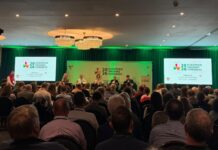

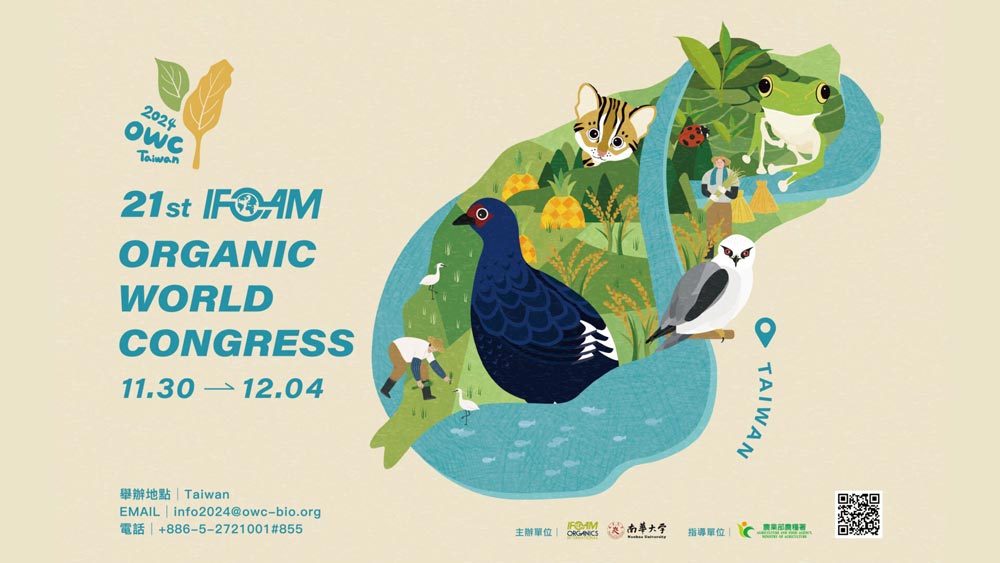
The Organic World Congress (OWC) in Taiwan has not been the biggest of its kind. However, the conference marks an invaluable milestone and perfectly managed to take the pulse of the remarkable progress towards Organic 3.0. The last 20 years have shown one big trend for organic development: Upwards! More farmers, more area, more trade, more consumption. The trend is not only quantitative as expressed in statistics, but can also be felt in the quality of the observed transformations and contents of the debates. Here are a few personal reflections from an OWC participant perspective.
Congress speakers increasingly view the food system as a whole and examine whole territories rather than single operations and technical issues. They focus on the impacts on people and the environment.
Organic is not alone anymore. Powerful concepts with similar goals, such as agroecology and regenerative organics, have emerged. Some circles (e.g., the UN system or big private sector investors) prefer to promote these terms. The organic movement welcomes synergies more and more.
Policymaking gains importance. Many countries successfully report on official organic targets, public procurement policies, public consumer information campaigns, research investments, or subsidies for environmental services.
Organic and agroecology policies are no longer limited to regulating production practices and labeling rules. They are used to reach overall policy goals such as the SDGs or climate change mitigation strategies. Organic regulations become less harmonized, and requirements become more demanding. Recognition based on equivalence gets under pressure. New group certification requirements raise the concern that certain value chains (e.g., cocoa or coffee) are expected to be undersupplied in the coming years.
Gender, youth, and indigenous groups get more attention. Their concerns are better recognized, and their cases are generally more supported. Overall, the OWC 2024 was a hub for transformative ideas and connecting global leaders.
The program featured four key themes: 1) Organic culture and lifestyle, 2) Knowledge and practice sharing, 3) Growing organic markets, and 4) Policies for scaling up organics and agroecology. Pre-conference events showcased Taiwan’s organic heritage through bio-tours and cultural exchanges. Key insights revealed a rising interest in localized food systems, regenerative agriculture, and consumer-driven markets for organic products. The General Assembly of IFOAM Organics International got its governance, and the movement prepared for the next three years until the 22nd Organic World Congress 2027 in the Philippines.
Author: Markus Arbenz, Organics4Development and FiBL, Research Institute of Organic Agriculture, Switzerland
Published in the BIOFACH 2025 Bio Eco Actual Special Edition.
Subscribe to Bio Eco Actual Newsletter and be up to date with the latest news from the Organic Sector
Bio Eco Actual, International Organic Newspaper
Read the BIOFACH 2025 Bio Eco Actual Special Edition