

Are intensively farmed areas with larger near-natural habitats (“land sparing”) or sustainable agriculture across a larger area (“land sharing”) better for biodiversity? A new literature review by FiBL helps to clarify the debate. The review finds that the data is incomplete, and neither approach alone offers a comprehensive solution. Both sustainably managed agricultural landscapes and suitable, undisturbed habitats are needed.

Protecting biodiversity at the landscape level is crucial. How best to achieve this protection is a matter of heated debate. Two opposing approaches compete in the agricultural debate: one calls for intensive production on less land and the use of more unused land to promote biodiversity. Production and biodiversity protection are separated as much as possible (“land sparing”). The other calls for landscapes in which sustainable agriculture and biodiversity promotion take place on closely interlinked agroecological production and near-natural areas (“land sharing”).
The debate on “land sparing” and “land sharing” is not constructive
This debate is often conducted using ideological arguments, and the two positions lead to very different recommendations for action. Some also emphasise that the debate does not do justice to the complexity of the topic and is not productive at all. Nevertheless, it remains present in the context of sustainable agriculture and biodiversity policy. FiBL has therefore systematically compiled and analysed the available empirical studies. This clarifies the facts and contributes to a more constructive discussion.
The data available is sparse and irregular – many important aspects are missing
There are only a few studies that present comparisons of the two strategies based on comprehensive field data. Of the 57 studies identified as relevant in the paper, only 17 provide the necessary data, while the other 40 studies lack important aspects. The studies focus on few animal or plant species groups each, and the studies as a whole are also one-sided: 19 of the 27 comparisons included in the 17 complete studies consider tropical forest birds, six consider different plants. Insects and soil organisms were considered by two studies each, and studies on microbes and fungi are missing entirely.
Both sustainably managed agricultural landscapes and suitable, undisturbed habitats are needed
Furthermore, only a few biodiversity indicators are covered. Most studies looked at species density (22 of the 27 complete comparisons). Analyses of species diversity, functional diversity, and other indicators are lacking.
Biodiversity requires sustainably managed land and undisturbed habitats
The results of the 17 studies that allow a true comparison of sharing and sparing show that in 50 percent of cases, a context-specific combination of the two strategies delivers the best results for promoting biodiversity. Sparing is better in 40 percent of cases, but these cases mainly concern forest birds that need contiguous, near-natural habitats, which are often lacking in agricultural landscapes. Sharing is better in 10 percent of cases. Biodiversity, therefore, depends on both undisturbed habitats and sustainably managed landscapes.
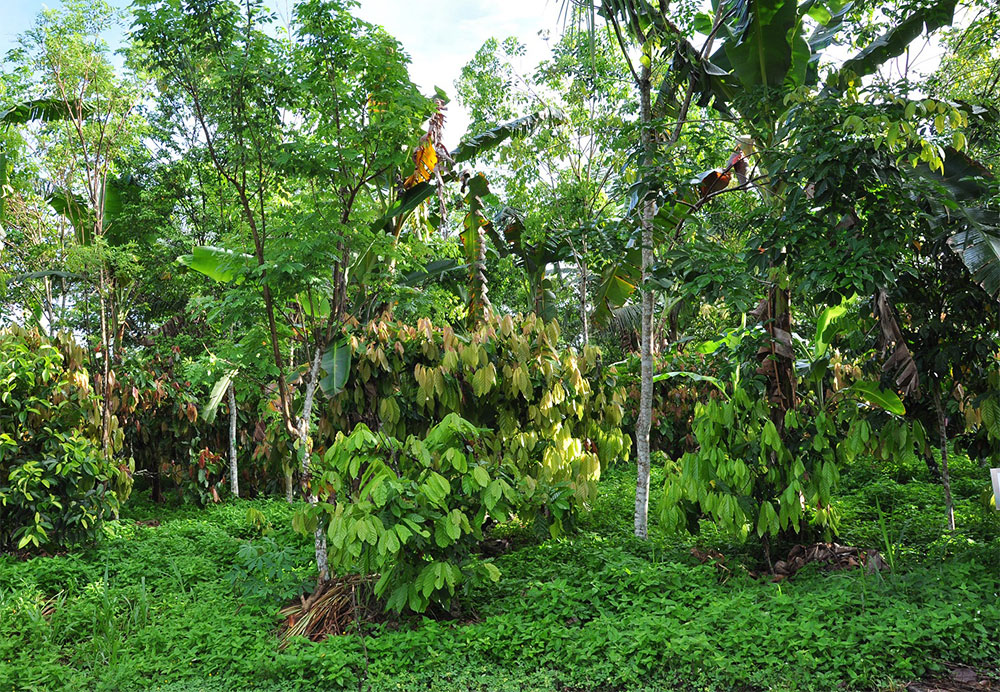
A focus on “sparing” with intensively used agricultural land is not a solution
The assessment of sharing and sparing strategies for promoting biodiversity at the landscape level must be carried out in a broader context. Intensive agriculture with high pesticide and fertiliser use can deliver high yields but has significant negative impacts on biodiversity. There is also a risk that yields will decline due to loss of soil health and erosion. Extensive or organic farming, with its agroecological approaches, is good for biodiversity, but is associated with lower yields.
It is essential to address the entire food system
Sustainable use of the aspects of sparing and sharing at the landscape level without jeopardising food security means considering productive, biodiversity-friendly agriculture on limited land in a systemic context. What is produced then becomes just as important as how it is produced: are we producing food or waste? In industrialised countries, one-third of production is wasted. Are we producing feed or food? In the European Union (EU), feed is grown on 60 percent of arable land. With consistent waste reduction and targeted use of arable land for food, both can be achieved: food security with sustainable agriculture and biodiversity protection.
Further information available at www.fibl.org
Subscribe to Bio Eco Actual Newsletter and be up to date with the latest news from the Organic Sector
Bio Eco Actual, International Organic Newspaper
Read Bio Eco Actual