
In recent years, practitioners, scientific actors, policymakers —including those from the FAO, the EU, and global forums such as the UN Food System Summit— as well as many countries, have increasingly promoted the concept of Agroecology.
Agroecology, the new organic?
Feedback has been overwhelmingly positive, and representatives of Agroecology (e.g., the global Agroecology Coalition, comprising around 50 countries) have observed a progressive shift in food systems toward Agroecology principles. Although hard numbers are difficult to obtain due to the broad scope of practices, governance models, and social dimensions, the global shift is qualitatively significant and institutionally visible.
Strong developments are particularly evident in Latin America and Sub-Saharan Africa, with growing momentum in Europe and Asia. Agroecology is applied in agroforestry, mixed crop–livestock systems, marginalized agroecosystems, dryland cereals, and urban and peri-urban agriculture.
Not certification, but what instead?
Organic marketing is well-established, based on regulations, standards, certification, and labeling systems that are widely recognized and trusted. Over the decades, a structured and expanding global market has been built. Agroecology is guided by 10 elements, 13 principles, and 10 “red flags” such as the prohibition of GMOs and highly processed foods.
Agroecology is not inspected against a standard, but its principles can be evaluated through tools
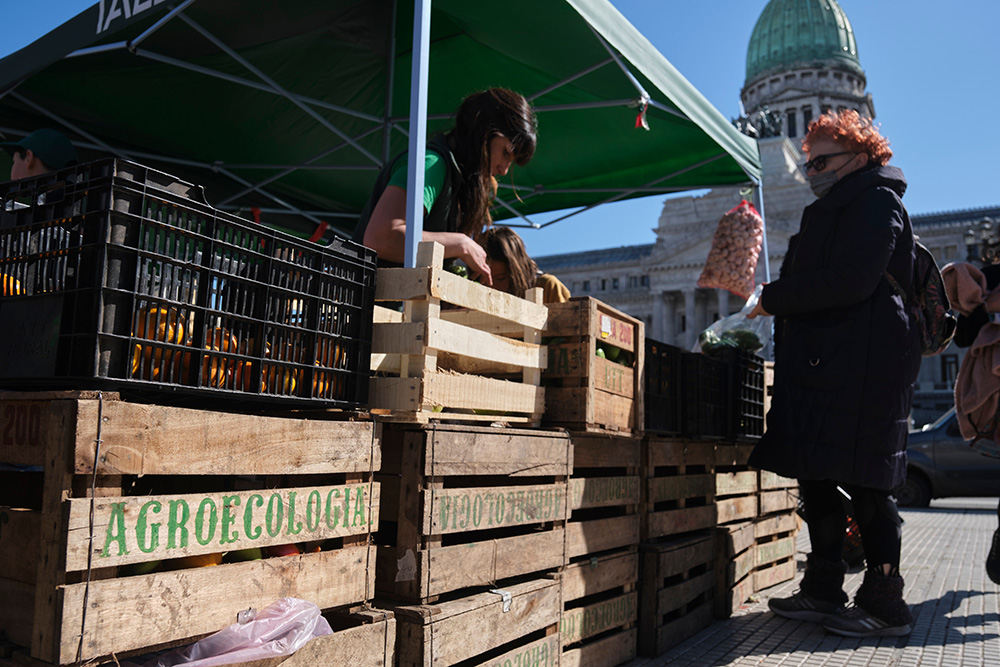
However, it does not rely on conformity assessments, long value chains, formal quality management systems, legal enforcement of claims, or retailer-driven promotion. Agroecology markets, if not using organic claims, primarily rely on direct sales, farmers’ markets, communitysupported agriculture (CSA), and farmto-school programs. In some cases, Participatory Guarantee Systems (PGS) are used. The agroecology claim is not widely established and works mainly where producers and consumers maintain direct, trust-based relationships.
Agroecology is not inspected against a standard, but its principles can be evaluated through tools, notably FAO’s TAPE and Biovision’s FACT/ B-ACT. These tools assess farms, landscapes, projects, and community food systems, etc. Agroecology is oriented toward systemic transitions and continuous improvement, so repeated assessments measure both current performance and progress over time.
Kilimohai: The Kenyan case
In Kenya, the Kilimohai organic label, managed by the Kenyan Organic Agriculture Network (KOAN), is well established. It uses a green organic label. In 2026, KOAN introduces a blue agroecology label, supported by FiBL. Unlike the green organic Kilimohai, the blue agroecology label is based on self-assessment using the Kenyan Agroecology Assessment Tool (KAAT), which is adapted from the TAPE and ACT. Operators must demonstrate compliance with “red lines” and show progress compared to previous years.
Author: Markus Arbenz, Organics4Development and FiBL, Research Institute of Organic Agriculture, Switzerland
Published in the BIOFACH 2026 Bio Eco Actual Special Edition.
Subscribe to Bio Eco Actual Newsletter and be up to date with the latest news from the Organic Sector
Bio Eco Actual, International Organic Newspaper
Read the BIOFACH 2026 Bio Eco Actual Special Edition