


Our food crops have to be continuously adapted to new pests, diseases or changing climate conditions. Breeders invest a lot of work to improve varieties accordingly. But in recent years, a growing number of patents on plants derived from classical breeding has put them in a situation where they risk not having access to genetic material or facing patent infringement lawsuits.
And all of this because big seed companies use legal loopholes and the European Patent Office keeps granting patents on classical breeding, even though this is against European patent law which says that only technical inventions are patentable, which in plant breeding means genetic engineering, but not classical breeding, such as crossing or selection.
One of the concerned breeders is Grietje Raaphorst-Travaille from Nordic Maize Breeding (Netherlands). She worked on a variety of organic maize that is adapted to colder climates. Their variety is threatened by a patent granted to the German company KWS in 2022 (EP3380618).
An opposition filed by No patents on seeds! has been rejected in 2024. “Presumably these plants had already been used in breeding for years before the patent application was filed. Now it seems unclear whether plants with these genetic traits can be used in future breeding. We cannot even search our varieties for the specific gene sequences, as even the relevant detection methods have been patented. Such patents can pull the rug out from under conventional breeding,” Grietje Raaphorst-Travaille says.
«If the monopolisation of conventional seeds is not stopped, we may no longer be able to afford to carry on with our traditional businesses»
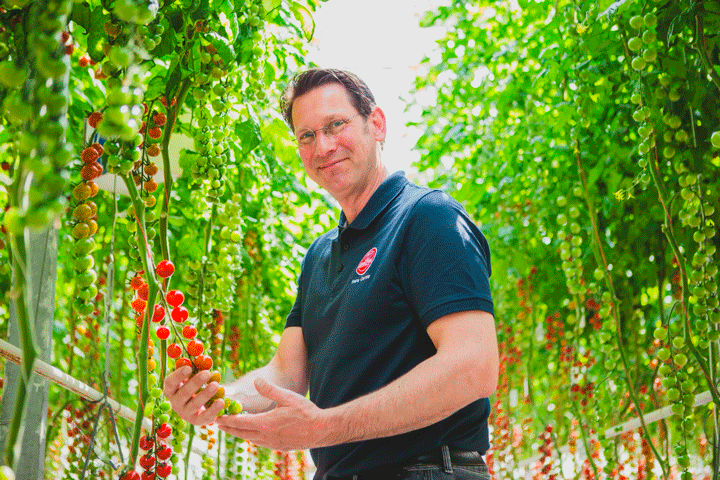
Frans Carree from the Dutch organic breeder De Bolster faces similar challenges. For example, the growing number of patents makes it very difficult to develop new tomato varieties that are resistant to a new virus (TBRFV). Around 20 patents have already been registered by 10 different companies.
In 2025, over 40 breeders and organisations filed a joint opposition against one of these patents (EP3629711, Vilmorin). We are still waiting for a decision by the EPO. “As breeders, we are deeply concerned about these patents and consider them to be unethical,” says Frans Carree. “If the monopolisation of conventional seeds is not stopped, we and other companies, may no longer be able to afford to carry on with our traditional businesses. This would have major negative consequences for gardeners, farmers and consumers interested in having access to a broad range of food plants.”
Political solutions are urgently needed to safeguard classical breeding in Europe.
Author: Johanna Eckhardt, No Patents on Seeds!, Project Coordination
- Further information: www.no-patents-on-seeds.org/en
Published in the BIOFACH 2026 Bio Eco Actual Special Edition.
Subscribe to Bio Eco Actual Newsletter and be up to date with the latest news from the Organic Sector
Bio Eco Actual, International Organic Newspaper
Read the BIOFACH 2026 Bio Eco Actual Special Edition