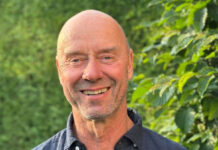

Klaus Hölzl is a South Tyrolean sales leader and agriculture entrepreneur with over 15 years of international experience in the fruit industry. As Head of Sales (CSO) at VOG – Home of Apples, he brings a strong sales-driven mindset, deep expertise in fruit products and organic markets, and a broad international network. Fluent in German, Italian, and English, Klaus combines strategic vision with hands-on industry knowledge, positioning VOG at the forefront of global apple marketing.
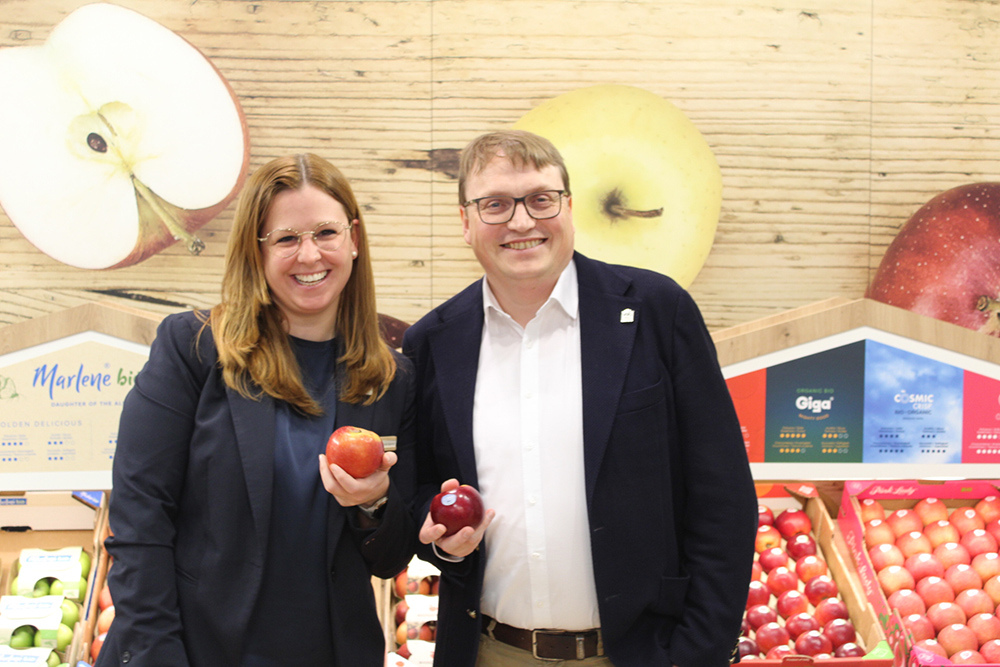
What did you bring this year to BIOFACH?
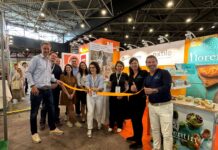
Organic is an important part of our portfolio. Around 10% of our production surface is organic, which means that we are one of the biggest organic apple producers in Europe, with close to 1,000 hectares. BIOFACH is the main organic fair in Europe, so it is important for us to showcase our products and our presence on the market.
Of course, this fair is dedicated to the organic segment in its entirety. And I would say it’s an important show. But you see that the people are willing to come to the show. We are also just coming from Fruit Logistica 2026 in Berlin, which is 100% dedicated to fruit and vegetables and, therefore, you see a lot of our customers, whom we have now seen twice in two weeks.
What do you bring back home from these two events, and what’s your feeling about the market?
Generally speaking, what we see is that the market is different in each single country in Europe. We cannot see a European market or a trend beside that fruit and vegetables, apples, and also organic products are an extremely important part of the purchasing basket of the consumers. Apples are, after bananas, the second most important fruit, actually. Therefore, almost everybody in Europe is buying some apples. But as I said before, the markets are different.
This year, especially in the south of Europe, like Italy and Spain, the market is a little bit better. It’s similar to last year, with an increase in the purchasing volume. In Germany, with a lot of local products, the market is not so active at the moment. But it’s still there and it’s still important. And, of course, we have Scandinavia, the UK, Belgium, and the Netherlands, which are also important markets.
So we see that the market is there, is growing and looking for new products and for a wide range. We are also able to offer a 12-month supply now with different products, with products that last until summer. This is something that we see and want to showcase to our customers.
In how many countries is VOG now operating?
We are operating in more than 70 countries on a global scale. In organic it’s a little bit less, it’s actually 40 countries on a global scale. It’s all Europe, a little bit also outside of Europe, especially in North Africa and the Middle East. We do something as well in Asia.
“We are also able to offer a 12-month supply now with different products, with products that last until summer. This is something that we want to showcase to our customers”
You mentioned that every country is a bit different, but what general trend do you see for your different brands? Is specialized retail now better than it was a few years ago?
We increasingly see this positive trend among large retailers, and this is ultimately where the industry’s growth is coming from, particularly in organic and for VOG. Rather than keeping organic products in separate sections, retailers are now integrating them directly into their main assortments, placing them on shelves alongside other products.
Do you think this works better?
In our opinion, it’s looking better, in a way that, people are looking for a product and find also the organic option. And so all the new customers are attracted to organic. If you have this organic island aside, those who are looking for organic products go there, hopefully finds the product they are looking for, but you are not attracting new customers. So we see that once we have the product included in the shelves, including vegetables, the sales of organic are increasing.
How do you make organic not a niche option?
That’s a challenging task. I think that the whole organic industry is working together on that. The thing is that, at the moment, the share of organic is quite low and not easy to increase. Also, in most cases, it’s a cost factor because organic production involves higher costs. It’s not that we are making money on that, and not everybody can afford this. That’s obviously an area to work on, but we try to offer different types of segments like a stand-up pouch, which can also be seen on the shelf, or a bag or a net with one kilo of organic apples (smaller ones, bigger ones, depending on the market) which are economically easier for a broader range of customers.
“Once we have the product included in the shelves, including vegetables, the sales of organic are increasing”
And on the production side, how can there be innovation when it comes to organic apples?
In the last years, we were always looking for new varieties, new products, new things. And people are looking for varieties which can be stored better. It’s also easier in the field itself, but especially in terms of storage capacity, in order to have a better product at the end of the season, in the summer. Especially in organic, the consumer prefers products from Europe. And therefore, we need to offer the right product at the right time.
That’s what we can do with our assortment. We have apples almost from January to December. Especially in summer, there used to be a gap in which some products were not available. Options were limited, and it was challenging to find organic apples in peak quality during the summer. With the products we have now, we have filled this gap. Also, other products like Giga®, RedPop® or Cosmic Crisp®, can last longer in the season. We would like to have a 12 month range. And our idea is to have, if possible, at least two different products on the shelves of the supermarkets in the organic segment.
Author: Oriol Urrutia, Bio Eco Actual Co-Editor
Subscribe to Bio Eco Actual Newsletter and be up to date with the latest news from the Organic Sector
Bio Eco Actual, International Organic Newspaper
Read Bio Eco Actual