
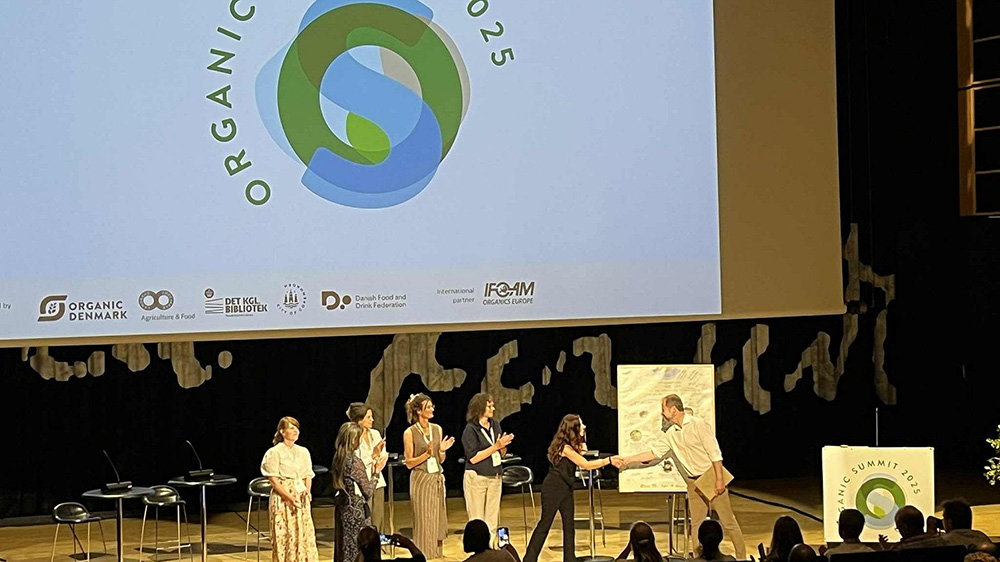
A Swedish delegation has participated in the Organic Summit in Copenhagen – a major food conference organized by Denmark as part of the country’s presidency of the EU. The conference concluded with decision-makers, researchers, farmers and companies from over 40 countries signing a declaration that shows the way towards the EU’s goal of 25% organic farmland by 2030.
Organic production contributes to more biodiversity, living topsoil, cleaner water, better animal welfare and a smaller climate footprint. The EU therefore sees organic production as an important tool for achieving many sustainability goals at the same time. That is why it has also set the target of 25% organic agricultural land by 2030. Now, measures are needed throughout the food chain to achieve the goal.
“The EU’s target of 25% organic agricultural land by 2030 applies to all member states – including Sweden. Here we came close to the target, but in recent years the organic area in our country has decreased to around 18%. The declaration adopted at the Organic Summit thus comes at a stage where the need for new measures to turn the market around is great. We have signed the plan and look forward to working to ensure that it is implemented,” says Charlotte Bladh André, CEO of Organic Sweden.
The Organic Summit in Copenhagen concluded with decision-makers, researchers, farmers and companies from over 40 countries signing the declaration
Three priority areas in the new declaration
1. Development of organic farming
- Policies that use organic production as a strategic tool to achieve our environmental and sustainability goals.
- Financial support that facilitates the transition to organic and compensates for the social benefits that organic farming delivers.
- Research and innovation that develops organic farming methods.
- Adapted advice so that farmers receive practical help and tools to develop their farms.
- Updated regulations that take into account developments and new knowledge.
2. Development of organic food businesses
- Support for SMEs, which are often the driving force of the organic sector.
- Simplified EU rules and reduced bureaucracy to make it easier for businesses to operate and grow.
- Export promotion measures to strengthen Europe’s position in the global organic market.
- Circular solutions where residues and by-products are used to reduce waste and increase resource efficiency.
3. Development of the organic market
- Better accessibility – organic food should be easy to find in shops, cafes and restaurants and in public kitchens.
- Campaigns and information to increase consumers’ knowledge of organic added value.
- Measurable targets for the public sector and an EU-wide “organic cuisine label”.
- Collaboration to develop and strengthen organic markets at local, national and European level.
- Protect transparency and trust in organic labelling and certification.
“It feels incredibly positive that we have worked on a declaration and a joint roadmap. Now it is crucial that we bring politics, the market and consumers along on the journey,” says Charlotte Bladh André, CEO of Organic Sweden.
The Swedish delegation included Organic Sweden together with KRAV, Organic Farmers, Sörmland Ecodistrict, MatLust Development Node, the City of Stockholm and the Swedish Board of Agriculture.
- Further information available at www.mynewsdesk.com/se/organic-sweden
Subscribe to Bio Eco Actual Newsletter and be up to date with the latest news from the Organic Sector
Bio Eco Actual, International Organic Newspaper
Read Bio Eco Actual