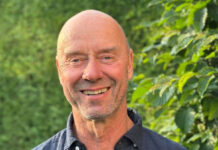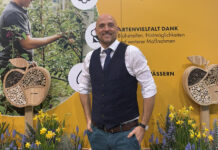

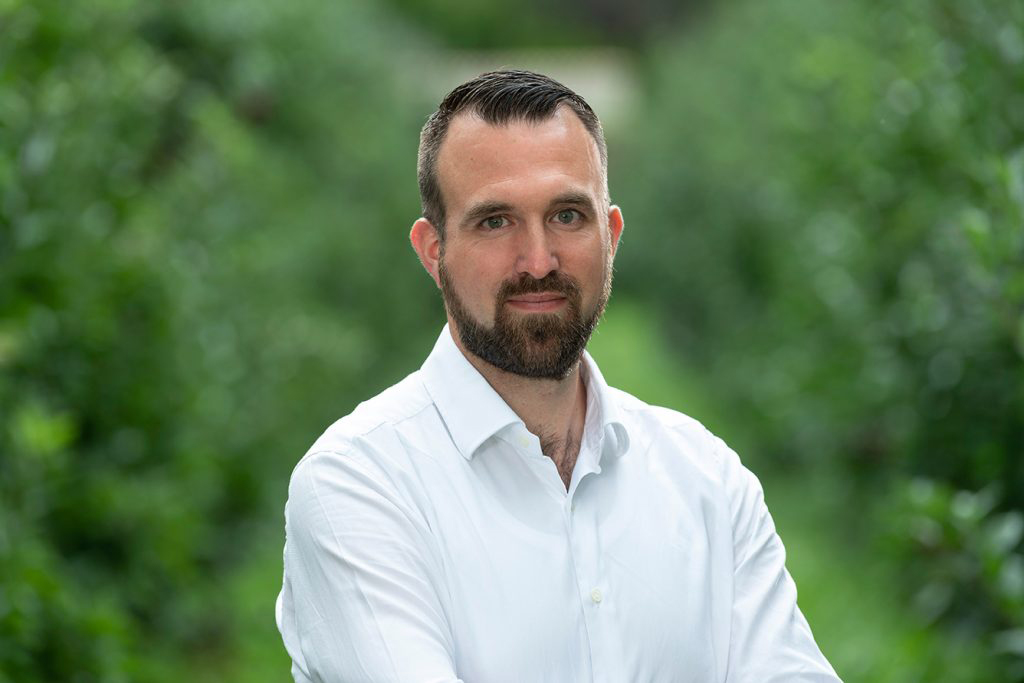
Hannes Tauber is the head of marketing for VOG Consortium. With 4,000 producers and 11 cooperatives, the Consortium of South Tyrolean Fruit Growers’ Cooperatives (VOG) is leading throughout Europe in the production and commercialisation of integrated and organic produced South Tyrolean apples in 75 countries. Over the last few years, VOG has consolidated its organic production, which now includes 350 organic producers and approximately 1,100 hectares of organic apple orchards.
What are your key takeaways from this edition of BIOFACH?
It’s very important to come together, for us and for the industry. It is about meeting clients, opinion leaders, and other organizations working within the organic sector. And having an exchange, trying to understand where there are opportunities, but also seeing if there are any risks for the sector. It’s a fair that has made its way over the years to become a reference for the organic sector. It’s an international fair, so it’s also possible to meet international visitors, which is also important to convey the message that the organic topic is not something that is only relevant on a national or local level, but rather a topic that is driving change at an international level, and therefore also requires joint thinking and collaboration.
We take home a lot of inspiration and new ideas but also feedback on what works well and where the industry needs to improve. I take home a rather positive feeling based on the numbers and figures. We are going in the right direction: there is an overall increase in volume consumption, but also in turnover. At the same time, we see a lot of challenges arising where we are not alone as a company, but the whole industry is facing those challenges, especially when it comes to production. Growers struggle because they need to ensure the right return on their investments to continue in the long term and to secure the budget to invest in innovation.
The market is moving very fast when it comes to consumer goods, and especially in the fruit and vegetables sector, where it takes time for certain developments. Therefore, this needs to be taken into consideration in policymaking and new market requirements, but also when it comes to new challenges to production, based on climatic conditions, the value chain, and logistics.
«The organic topic is not something that is only relevant on a national or local level, but rather a topic that is driving change at an international level, and therefore also requires joint thinking and collaboration»
What quality standards must an apple meet?
Our sustainability seal does not exclude the organic label. Both need to work in the same direction because they are compatible concepts. The important thing is that they are visible and efficient.
If quality seals are able to provide the right information that consumers need to see (an added value) and the grower is able to provide that, then the consumer is willing to pay the right price for what they get, and the grower receives the right return in order to continue and invest. This is the overall concept that needs to work in the long term.
At VOG, we are an organization made up of farming families. We have 350 organic farmers that are part of our organization. They have been apple growers for many generations, and our objectives and our vision ensure that they also have a future in apple growing for the next generation (for their kids and grandchildren). So, when it comes to quality seals, I think we need to consider creating a good environment where they have opportunities to continue growing fruit and vegetables. And at the same time, the consumer receives key information to understand that this is important and valuable, which is why they are willing to pay the right price.
And what should be the unifying element for all of this? Should it be the EU Organic logo?
What is very important is a joint approach towards this kind of certification and this kind of communication. The direction should be a shared one, and, in the end, we need to understand how to avoid confusing the consumer with too many different messages, certifications, or labels. Instead, we should understand the key element to which we can all contribute in order to make it work, ensuring that the consumer is satisfied, and the grower can continue producing. Therefore, it is necessary to involve all stakeholders along the value chain. You need to understand the consumer but also work with the grower to understand their needs and ensure continuity. I would not say that it comes down to one certification or another. It’s a message we need to give to the consumer. And don’t go too technical.
For consumers, technical details can be difficult to understand. We have a lot of potential consumers who could buy more organic products, but very often, their purchases are not planned. You might see a product or a message and say ‘This is nice. This attracts me. This is something I want to try’. These are the messages that we need to deliver.
«You need to understand the consumer, but also work with the grower to understand what their necessities are and ensure continuity»
Why is VOG the ‘Home of Apples’? How is organic production evolving in the region?
We have more than 4,000 farmers who are organized in 11 cooperatives. Within that group of farmers, we have 350 fully organic farmers and one cooperative that is exclusively working on that organic product. Organic farming represents around 10% of our cultivated area. We have approximately 10,700 hectares of apple growing in the South Tyrolean alpine Mediterranean climate, at different altitudes ranging from the 200 to more than 1,000 meters. We focus on finding the right place for every variety because the requirements are different, and around 10% of that surface is organic.
The organic farmland has been growing in recent years, and is now consolidating. We have approximately 1,1000 hectares of organic apples and are also developing the markets for that production. At this stage, it remains stable.
Should the European Commission’s objectives of setting targets for production but not for demand change?
You need to see the entire value chain because if not, you risk disrupting the value chain and creating a situation that is difficult to fix afterwards. A value chain means thinking from the grower all the way to the consumer. If there is a target on a grower level, we need to have a realistic target based on an understanding of consumers and what a realistic target for consumption is. And you cannot generalize by just saying everybody needs to grow because that simply will not happen. If you predict that the consumption of organic products will increase to approximately 25%, then you need to be very careful in analyzing the data and assessing whether this is actually feasible for the market. Setting targets only on one side creates an expectation, especially when communicated at a certain level. So, if it’s just at a local level, that is one thing. However, if it’s being communicated at a European level, then the farmers expect this to be the direction for the future.
And if you create this expectation, then you need to deliver. Who is setting the goals, and who is implementing them and making sure that these goals are also met at the consumer level? This is not clearly defined, and therefore, there needs to be very clear messaging regarding the targets for production and for consumption. It cannot be left to chance, assuming it will happen on its own. Instead, it must be clearly defined who has which task.
«It’s not just about one certification or another; it’s about delivering the right message to the consumer. And we shouldn’t get too technical»
What is VOG’s day-to-day activity like?
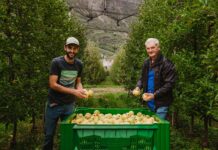
We have experts throughout the value chain. We are a fully integrated, vertically structured company, meaning that our farmers are experts who work year-round. Now, during winter, they are pruning the trees. In spring, they protect the flowers during bloom and ensure the quality of the apples by managing the right balance of flowers and fruit on each tree. In summer, they maintain irrigation, cut the grass, prune the trees, and control insects and diseases. Then, in autumn, they harvest the apples.
At harvest time, the farmers bring the apples to the cooperatives where they are members. This is when the daily operations begin. Each of the 11 cooperative stores, washes, sorts, packs, and ships apples, working throughout the entire year to ensure continuous supply.
On the corporate side, the company oversees sales, quality control, marketing, and administration. We work with clients, manage campaigns, control quality, and ensure that all processes run smoothly.
These are the three main parts of our company, all interlinked as a part of a single company. And then we work on the market with the retailers in order to reach consumers.
The cooperatives are 100% owned by the farmers, there are no other investors. All profits, after covering operational costs, go back to the farmers.
Do you know about other similar models through Europe?
There are other similar models throughout Europe, especially in our region. Ours is a good example when it comes to a vertically integrated system of small, family-run farms. The FAO conducted a case study and nominated our model as a learning example for other realities around the globe. The study highlights how small family farms can work together to ensure a sustainable long-term future. There are a lot of other companies involved when it comes to research and development, advising farmers, and finding new solutions for storage or packaging. There’s a huge network that works in order to ensure our future.
How would you describe the current consumption situation in Europe?
There is a general positive feeling. It’s not euphoric, but we see that it’s going in the right direction. There is still a lot of work to do, particularly in increasing consumption, strengthening collaboration along the value chain, and fostering a shared understanding between growers, packers, and retailers. It’s essential that all stakeholders recognize both the needs and potential of each sector to achieve long-term, common goals.
A key factor will be collaboration and partnership, so that we can find common objectives, and develop joint strategies in order to achieve them. This requires a strong understanding of the different roles within the value chain.
The fruit and vegetable industry is becoming increasingly professionalized. Having the right people at the table to discuss future strategies will be crucial.
«If there is a target on a grower level, we need to have a realistic target based on an understanding of consumers»
How is this commercial season developing so far?
This year, we have a harvest of 35,000 tonnes of organic apples. That’s around 180.000.000 apples. An incredible number, considering each apple is picked individually. We have a good harvest quality and a wide range of varieties ensuring availability. Certain markets are under pressure when it comes to production, but in the coming months, we’ll get a clearer picture of how the season will unfold. It’s still a bit early to determine the overall performance, as the peak sales season is just beginning. However, we do operate on a 12-month sales cycle.
Can you give an example of VOG’s actions to drive new consumption?
One of our topics this year at BIOFACH was varieties and innovation, so we supported ‘apple sommeliers’ to study the sensory properties of an apple and try to understand how to describe them based on texture, aroma and taste. Based on those characteristics, we try to find new pairings. With our partners at the fair, we put together unique products based on their characteristics. One pairing features a fresh yet creamy yogurt with a slight sourness, combined with the Cosmic Crisp® apple, which is crisp and sweet. Another pairing includes a very crisp and aromatic Giga® apple, matched with an aromatic ham that has a rich, creamy flavour profile. Finally, the crisp, tropical-fruity apple Natura® harmonizes with soft, intensely flavored bread.
This is one way to boost consumption, by explaining to consumers how to use an apple, how to combine it with other products, to create new consumption moments.
Author: Oriol Urrutia, Bio Eco Actual Co-Editor
Subscribe to Bio Eco Actual Newsletter and be up to date with the latest news from the Organic Sector
Bio Eco Actual, International Organic Newspaper
Read Bio Eco Actual