
If the solidity of the German organic market has impressed us for several years, its current dynamism exceeds expectations: with growth of nearly 7%, the world’s second-largest organic market is enjoying a renewed sense of vitality. Considered a mature market for decades, Germany is managing to activate several growth drivers. The market share of organic products in the country has reached 6.6%.
The German organic market is growing faster than the conventional market
The growth of the German organic market is reflected both in turnover and volume. In 2024, the market was held back by the limited availability of certain products, especially fruit and vegetables. In these categories, better and more abundant harvests boosted the market. However, the strongest growth has been recorded in white meats, plant-based alternatives to milk and meat, and dairy products. Nevertheless, some shortages persisted, for example in red meats.
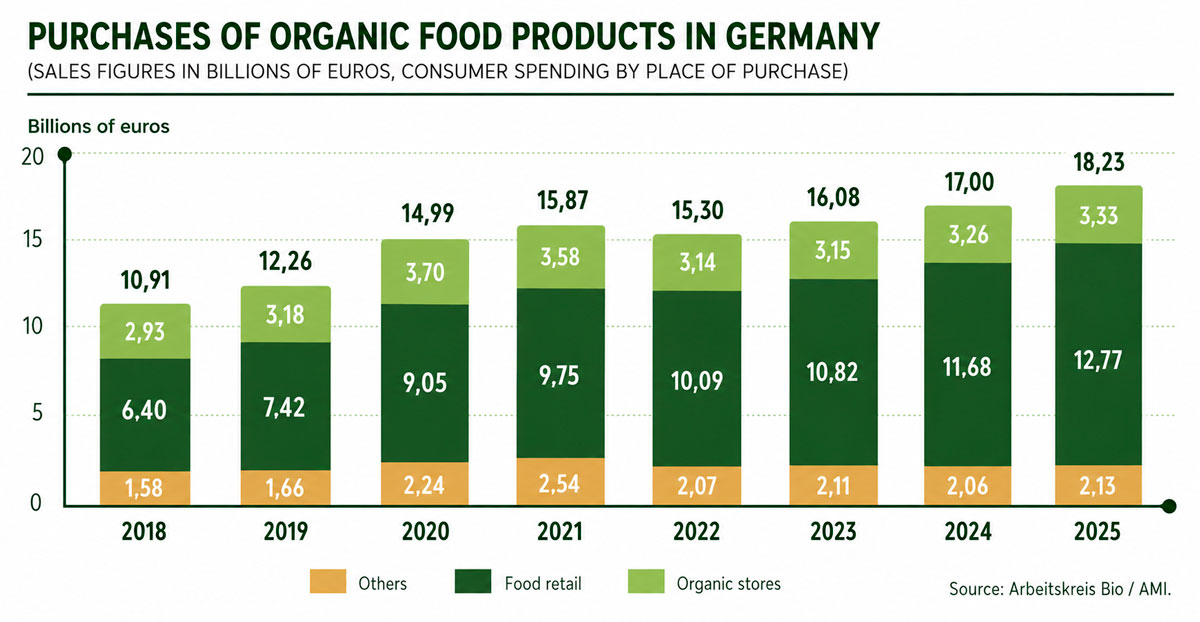
In terms of distribution channels, organic shops are holding up well with, according to estimates, between 1.5% and 2.3% growth. Specialist organic retail continues to face increasingly strong competition from mainstream retail.
In fact, conventional retail as a whole is showing growth three times higher: 8.7%. Within conventional retail, discount stores are growing by 6.7%, supermarkets and hypermarkets by 8.6%, and the very particular “Drogeriemärkte”* format by 15%. Drogeriemärkte are therefore by far the most dynamic channel, as was already the case in 2024. It is worth noting that discount retail, despite a significant expansion of its organic assortments, is progressing more slowly than mainstream retail.
The “Others” channel is returning to growth: direct sales, bakeries, delicatessens, service stations, etc. This is reassuring, especially because direct sales had lost market share in the past and are now gaining momentum again. The share of organic products in out-of-home catering also appears to be increasing, although solid consolidated data for the sector as a whole are still lacking.
« Organic shops are holding up well with, according to estimates, between 1.5% and 2.3% growth »
What will 2026 bring?
Will the organic market in Germany run out of steam? It seems unlikely. The healthy competition among conventional retail chains, both in supermarkets and discount stores, around the question of “who will have the best organic offer” continues and is driving the market forward. With organic shops and direct sales revitalised, and online retail also experiencing strong growth, nothing stands in the way of positive development. However, major challenges will shape future growth:
- In mainstream retail, private labels already account for two thirds of the market and are putting pressure on margins at all levels of the value chain;
- Domestic production is increasing by only 1.1%, forcing Germany to rely increasingly on imports, while consumers are demanding more and more regional origin for organic products.
The organic market in Germany confirms its strength in 2025, but businesses and policymakers must urgently address the issue of insufficient domestic production. Some market players are already announcing private premiums for farms converting to organic agriculture and, in principle, political objectives and programmes remain in place across the different German regions. It remains to be seen in 2026 whether this will be enough to reactivate conversions.
*“Drogeriemarkt” is a retail format that is typically German. It mainly offers hygiene and cleaning products, but also organic products (excluding fresh products, only dry goods). Some examples of national chains are: “dm”, “Rossmann”, “Drogeriemarkt Müller” and “Budni”.
The article Le marché bio en Allemagne bat tous les records avec 18,2 milliards d’euros was originally published in Bio Linéaires.
Author: Burkard Schäer – schaer@ecozept.com www.ecozept.com

Subscribe to Bio Eco Actual Newsletter and be up to date with the latest news from the Organic Sector
Bio Eco Actual, International Organic Newspaper
Read the Bio Eco Actual International Yearbok 2025 – Trends 2026