
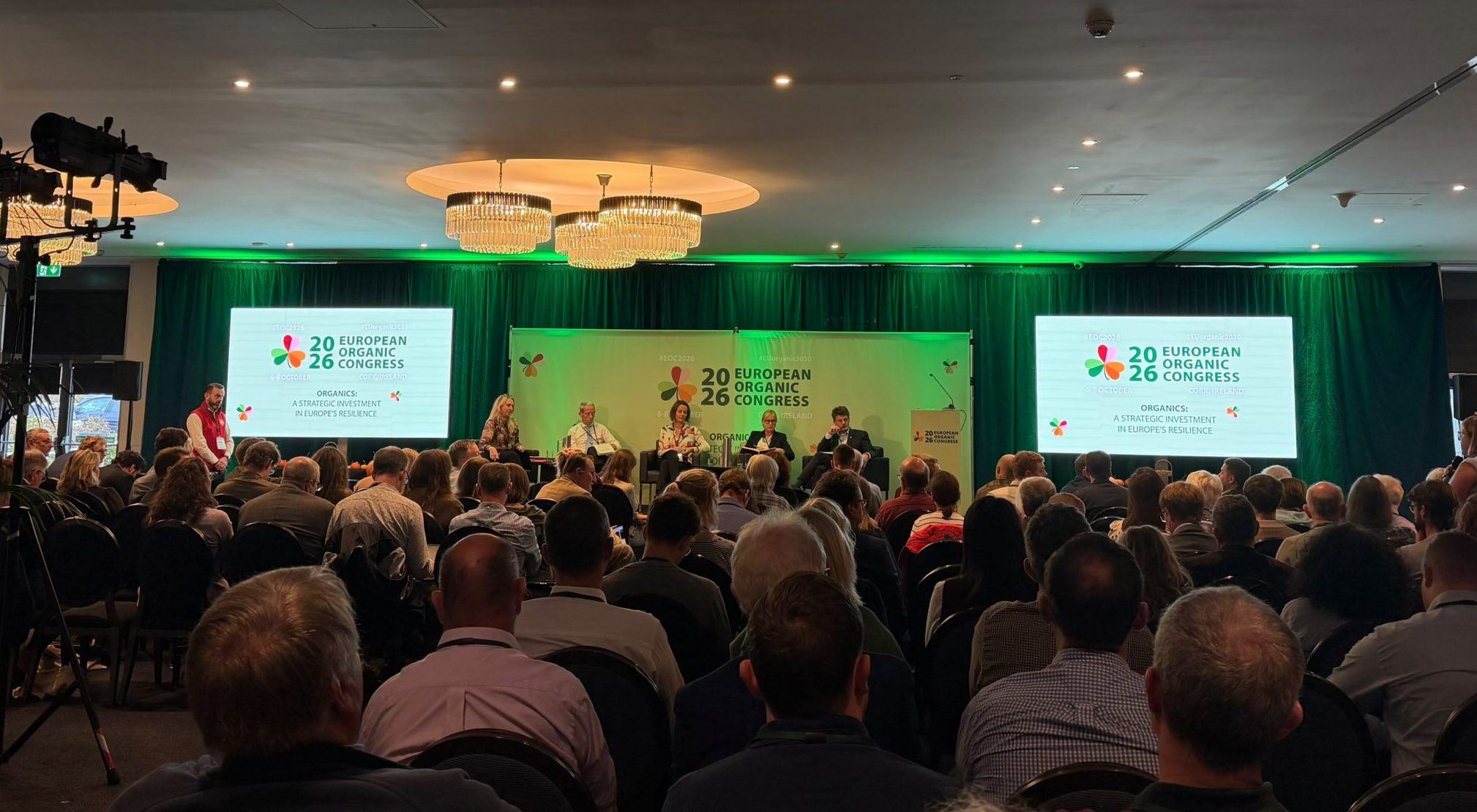
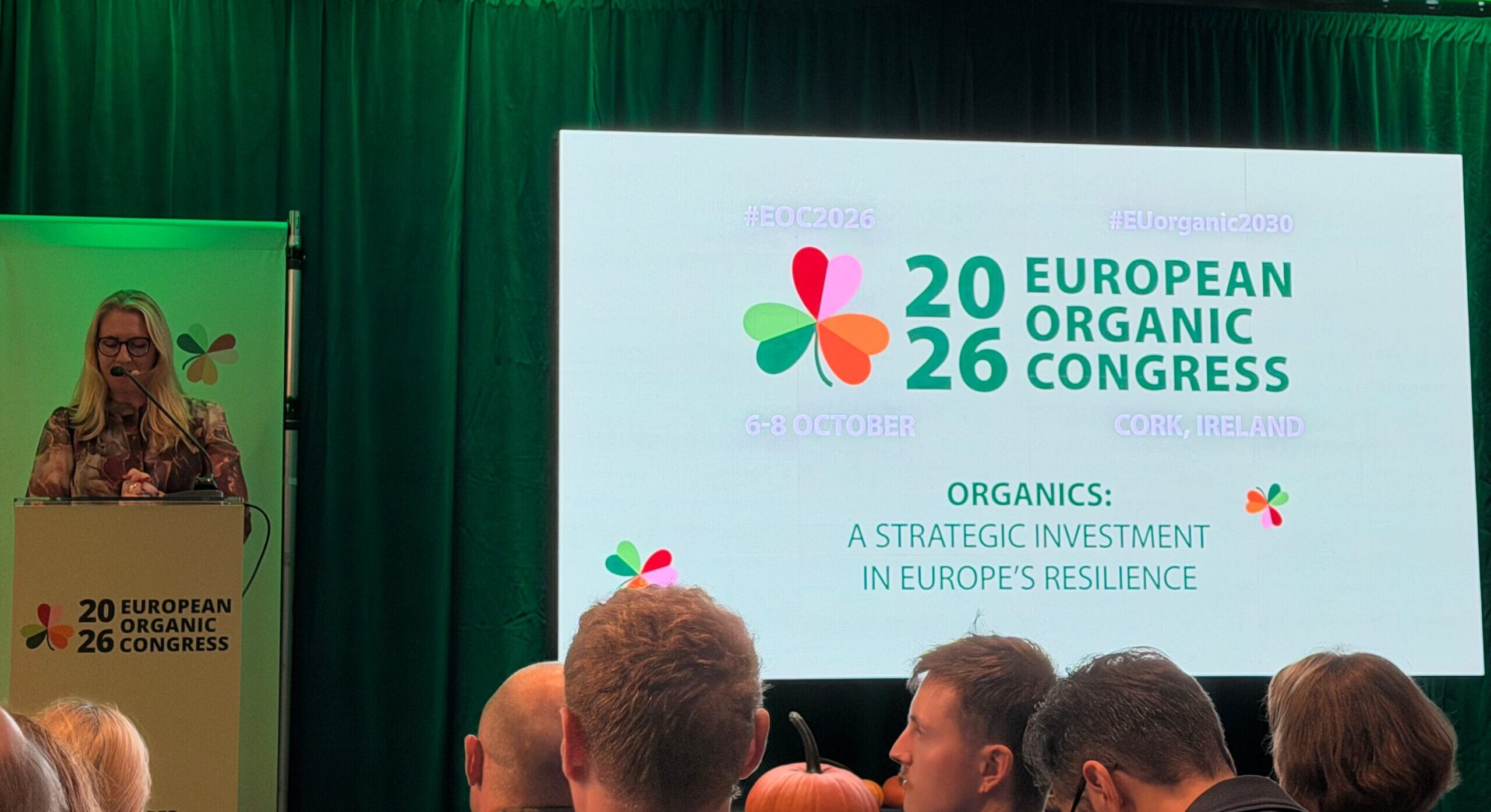
Europe’s organic sector needs a predictable policy framework and investment that connects farms with markets. This was a central message of the European Organic Congress, which brought together more than 260 participants in Cork, Ireland, from 6 to 8 October. Discussions linked the future of European agricultural policy with the practical challenges facing farmers, processors and distributors.
Organised by IFOAM Organics Europe together with Ireland’s Department of Agriculture, Food and the Marine, and in partnership with the Irish Organic Association, the event took place in association with the Irish Presidency of the Council of the EU. Under the theme “Organics: A strategic investment in Europe’s resilience”, it brought together policymakers, businesses, researchers and civil society. Bio Eco Actual was the Congress’s media partner.
Turning political recognition into dependable support
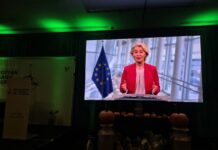
In video messages, European Commission President Ursula von der Leyen and Commissioner for Agriculture and Food Christophe Hansen highlighted organic farming’s contribution to European resilience. Reducing dependence on external inputs, protecting natural resources and strengthening rural communities were among the benefits discussed.
The debate on the future Common Agricultural Policy (CAP) focused on how to translate that recognition into reliable support. Dóra Drexler, President of IFOAM Organics Europe, called for systematic investment in farming systems capable of withstanding shocks. Dedicated funding for conversion and maintenance, alongside support for environmental and climate action, featured prominently.
Gillian Westbrook, CEO of the Irish Organic Association, pointed to Ireland’s experience with clear targets, dependable funding and coordination between national policies. Jürn Sanders, President of FiBL Europe, raised the need to maintain a level playing field as national flexibility increases. For farmers considering conversion, confidence depends on the conditions they can expect over the coming years.
Investment along the food chain
Expanding production requires processing capacity, logistics and dependable routes to market. Pat O’Sullivan, founder of Master Chefs and Ellan Farm, described the difficulties of sourcing organic food consistently for catering. Food hubs and coordinated logistics were discussed as practical ways to connect growers with buyers, while Margaret Edgill’s experience at Mount Briscoe illustrated the potential of shared processing facilities.
The proposed European Competitiveness Fund was considered as a possible complement to CAP and research funding. The discussion also linked long-term investment to soil health, water management and infrastructure that can help farms prepare for future crises.
Demand is recovering, but supply remains uneven
The market sessions described renewed growth in several European markets and strong demand in the United States, with differences between countries and sales channels. Lee Holdstock, from Soil Association Certification, highlighted cases where domestic production is struggling to keep pace with demand. Tom Chapman, Co-CEO of the Organic Trade Association, also drew attention to supply constraints and policy uncertainty.
Public procurement, shorter supply chains and retail partnerships were among the approaches discussed to make organic food an everyday choice. Affordability needs to go hand in hand with fair returns for farmers and processors. Taste, quality and clear certification offer a basis for communication supported by evidence and consumer trust.
Generational renewal and the debate towards 2040
Generational renewal ran through the Congress. Access to land, finance, training and advice remains essential, while examples of direct sales, processing, tourism and education showed different ways to build viable rural businesses.
Discussions on the EU Organic Regulation stressed practical simplification, regulatory stability and trade continuity while safeguarding organic principles. The Vision 2040 workshops broadened the debate to fairer value chains, gender balance and responsible access to technology and knowledge.
The Congress also marked the start of celebrations ahead of IFOAM Organics Europe’s 25th anniversary in 2027. The next edition will take place in Kaunas, Lithuania, in June 2027. The negotiations on the next CAP will be an important test of whether the political recognition expressed in Cork translates into funding and conditions that allow farmers and businesses to invest.
Subscribe to Bio Eco Actual Newsletter and be up to date with the latest news from the Organic Sector
Bio Eco Actual, International Organic Trade Media
Read the Bio Eco Actual International Yearbok 2025 – Trends 2026