

IFOAM Organics Europe president Jan Plagge, speaking at the event “What comes after the CAP proposals”, organised by AGRA Europe on 2 March, highlighted the importance of re-introducing ringfencing for agri-environmental measures in the future CAP budget to ensure a level-playing field between the different Member States when it comes to financing the transition towards sustainability in the agricultural sector.
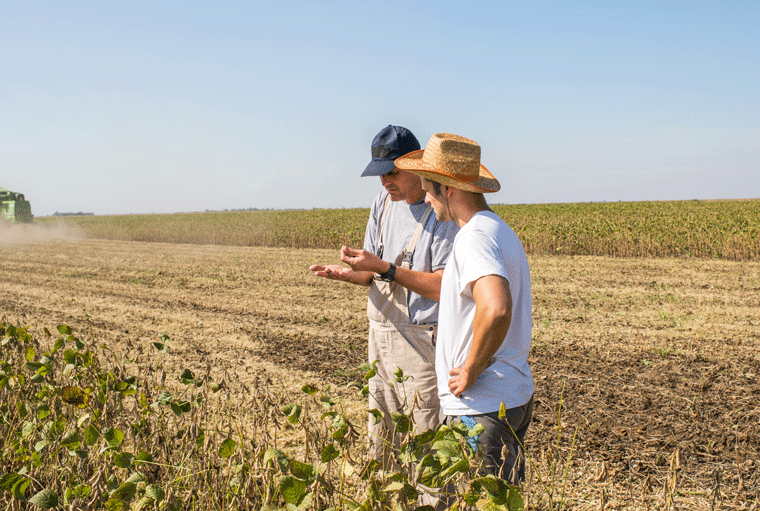
Plagge reminded the essential contribution of organic for many challenges faced by European agriculture, including generational renewal: “Organic agriculture is more attractive to young people as a life choice for their farm, and statistics show that there are twice as many young farmers in organic. Yet organic farmers face the same challenges as all young farmers for access to land and access to finance, and it is a good idea to give higher area-based payments to young farmers, and to organic farmers.”
Beyond generational renewal, organic farming plays a key role in making the EU agri-food system more sustainable. Its benefits are numerous, going from reducing the use of synthetic pesticides, lowering the EU’s dependency on synthetic intrants, protecting the health of farmers and EU citizens, biodiversity and water quality and contributing to Europe’s food sovereignty, but also revitalising rural areas and offering new opportunities to youth to stay in said rural areas thanks to economic prospects. The organic sector also has positive effects on the whole agricultural sector by spillover effect; hence this should be considered when discussing the future of the CAP but also the future of the whole EU budget, the Multiannual Financial Framework (MFF).
“Statistics show that there are twice as many young farmers in organic”
However, Plagge warned: “Farmers engaged into sustainable practices like organic agriculture need a stable policy support that provides a long-term perspective. While many decisions on the CAP will have to be taken at national level, organic agriculture is the simplest and most efficient way for Member States at the administrative level, while ensuring high environmental ambitions, since it is legally regulated at the EU level and already has strong certification systems in place. Policymakers need to ensure that the public goods delivered by organic farmers are adequately remunerated through the CAP, be it by ringfencing a certain amount of money for agri-environmental payments or ensuring a strong level of EU financing for organic farmers. Farmers will engage into sustainability if it is profitable, so we need a level playing field in the EU to ensure that sustainability pays off for farmers.”
IFOAM Organics Europe will emphasise these propositions during a public event it organises in the European Parliament on 4 March, under the patronage of MEPs Camilla Laureti and Dario Nardella, and with the participation of MEPs from several political groups. The event will discuss how to make these demands operational during the co-decision process on the CAP and the National and Regional Partnership Plans which will take place in the coming months.
- Further information available at www.organicseurope.bio