
Initiated by So.bio and carried out by Ifop, an exclusive study sheds light on the psychological and budgetary mechanisms of organic product consumers in France. While 74% of French people say they have bought organic products during the year, a majority —the «mixers»— constantly move between organic and conventional. The study outlines the profile of these new organic consumers, between convictions, constraints and purchasing decisions.
Organic consumers with very varied profiles
One of the main conclusions of the study* lies in the emergence of a profile that has become the majority in organic product purchasing behaviours: that of the «mixers». These consumers alternate between organic and conventional products depending on the categories, uses, health-related aspects or even price differences. According to Ifop, nearly four out of ten French people currently belong to this category.
The study also segments organic consumers into six major behavioural families:
- The Organic Believers (12%) : Younger and with a higher level of education, the label is a trusted reference point for them and a tool for overall control (health, environment, ethics). They buy organic products regularly and through specialist networks.
- The Demanding Organic Consumers (16%) : Older and with greater purchasing power, they have a mature and quality-focused approach. For them, organic only makes sense if it is associated with taste, French origin, minimally processed products and a fair price.
- The Pragmatic Organic Families (15%) : Very favourable to organic, they buy it to protect children’s health and for products that are sensitive from a health perspective. However, organic must remain compatible with the household budget and the practical organisation of everyday life.
- The Responsible Mixers (17%) : Often women or households without children, they integrate organic selectively to stay in line with their values, without ruling out conventional products depending on the opportunities.
- The Precautionary Mixers (14%) : For them, organic is a “health insurance” option in certain specific categories (less processed products…). Neither converted nor closed off, they switch from organic to conventional depending on the products.
- The Opportunists (17%) : Habitual supermarket shoppers, they add organic products to their basket only if the price is very similar to the conventional equivalent. Although they largely trust the label, organic is still associated with a high price and a promise that is sometimes perceived as too commercial.
- The Distant-Sceptics (10%) : They are older, mostly men (58%), with lower purchasing power and a lower level of education than the average consumer. They buy organic products very rarely and have little trust in the label.
The engagement factors:
- The key categories: eggs, fruit and vegetables, baby food.
- The existence of strict certification remains a key factor of trust compared with the ambiguity of private initiatives.
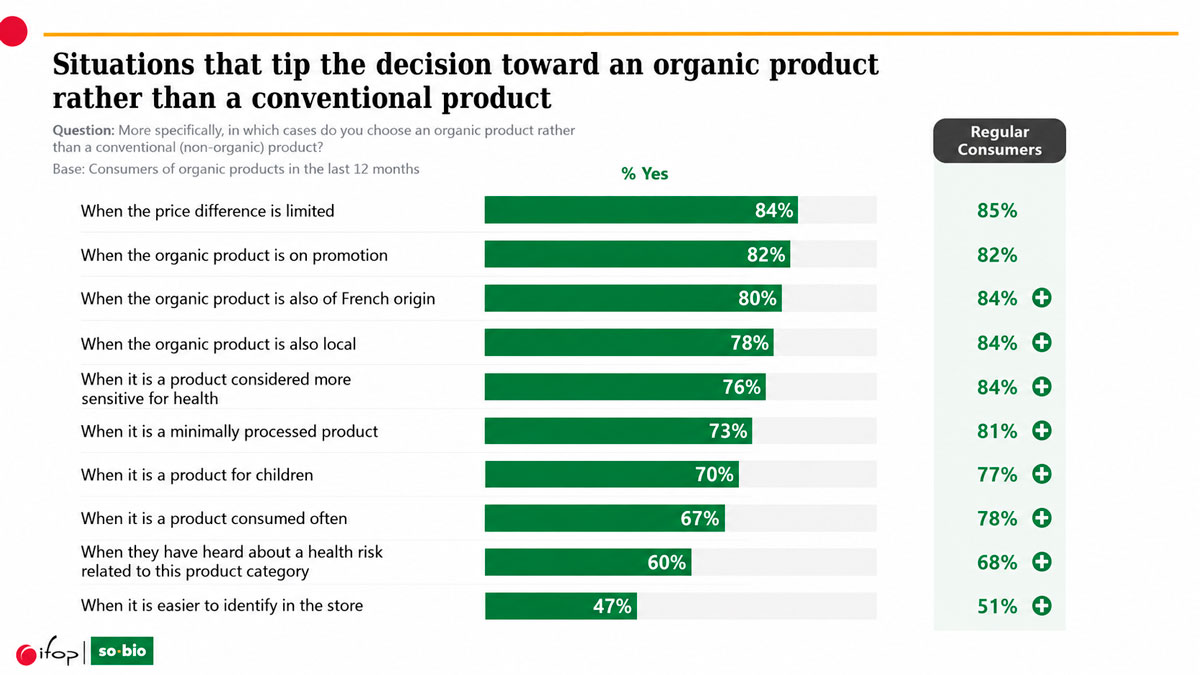
- A price difference considered reasonable / promotions: price is the main purchase trigger that makes «mixer» and «opportunist» profiles opt for organic.
Price, the first barrier, but not the only one
This Ifop study identifies the points of friction and the triggers behind the act of purchase.
The main barriers:
- Price and the unjustified difference : 87% of respondents still consider organic products to be too expensive and only one third accept a significant extra cost when the benefit of organic is clearly identified. Conversely, 21% give up organic as soon as it becomes more expensive and 39% only accept a small price difference.
- Lack of clarity and competing promises : The proliferation of criteria (organic, local, French origin, composition, level of processing…) creates a real “mental load” for consumers at the time of purchase (80% of organic consumers find it difficult to do well on all criteria at once; 76% say they do “the best they can” without being able to be consistent with every purchase; 72% say they have to choose between their convictions and their budget).
- Ultra-processing and organic do not go well together : 75% of organic consumers say they give up buying an organic product when it seems too industrial or processed, a figure close to that observed for the price barrier (82%).
Consumers no longer buy just a label; they are looking for overall coherence between organic, naturalness, a short ingredient list and low processing.
Health: the territory of organic remains underused
The study recalls that health remains the main driver for purchasing organic products. Among organic consumers, 58% say they buy these products above all to preserve their health (71% among regular organic consumers), far ahead of taste (39%). At the same time, health concerns are increasing sharply:
- 45% of French people are concerned about pesticide residues in food products (53% among regular organic consumers);
- 40% about PFAS (50% among regular consumers);
- 39% about microplastics (43%);
- 37% about heavy metals such as cadmium (43%) .
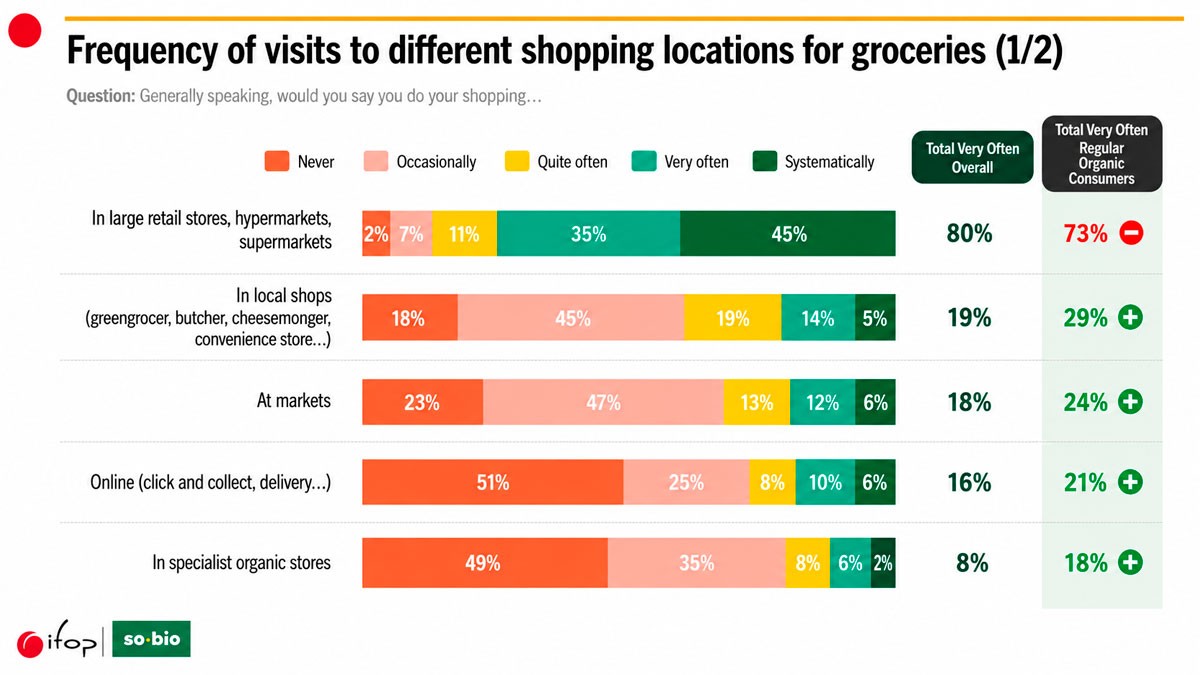
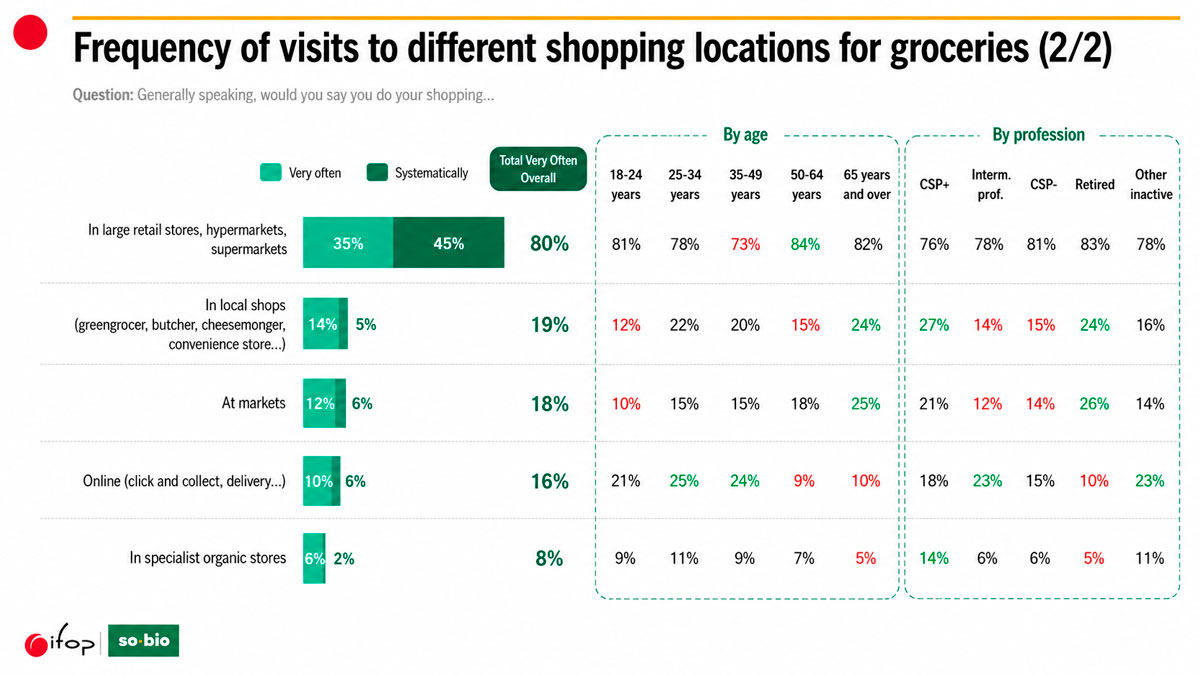
However, Ifop emphasises that these concerns do not automatically lead consumers towards organic (see the chart below). Faced with food risks, consumers often prioritise other reference points considered easier to understand: local, French origin or minimally processed products.
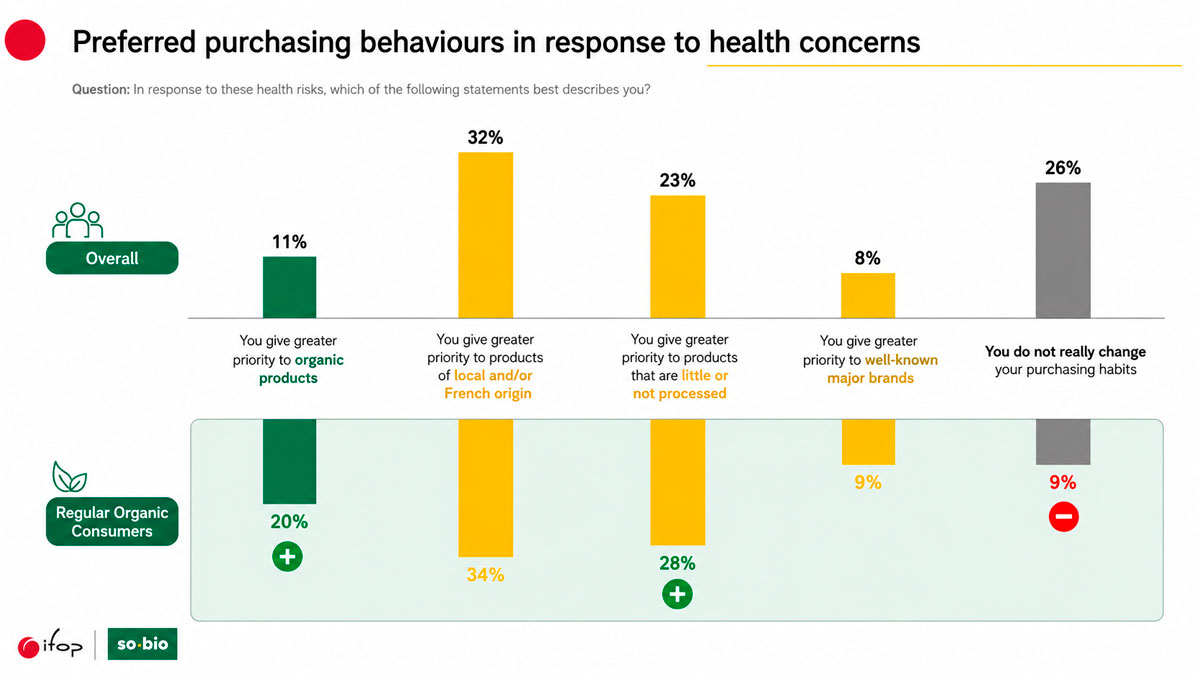
One of the conclusions for the sector is therefore the need to better highlight the specific health benefits of organic, which are still insufficiently known. Reduced exposure to pesticides, exclusion of PFAS in certified organic cosmetics, prohibition of numerous additives and solvents: these are advantages that deserve greater educational effort. And, for organic shops, which often have a local and/or made in France offer, to highlight it for consumers.
Young people: more committed… but facing more barriers
The study also highlights the strong trust of younger people (18-24 years old) in the organic label (78% compared with 65% of organic consumers overall). 75% consider organic purchasing to be rewarding and 61% say they feel guilty when choosing a conventional product while an organic alternative exists. But they are the most economically constrained: 80% say they have to choose between their convictions and their budget.
«Young people aged 18 to 24 want to consume much more organic than their elders, and much more for environmental and animal welfare reasons. But they are also the most constrained by their purchasing power. More broadly, this study shows that French people have a high level of trust in the organic label and that they prioritise it almost as much to limit pesticide residues as exposure to PFAS and heavy metals such as cadmium. Our role as a retailer is to reduce the price barrier. This is where So.bio wants to act», Florence Gomez, General Manager of So.bio
So.bio: an action plan focused on accessibility
In response to this study, So.bio (145 stores in France with its associated networks Bio c’ Bon and Le Grand Panier Bio) announces the rollout of several measures:
- a permanent 10% reduction for under-25s across all of its 145 stores (including Bio c’Bon and Le Grand Panier Bio), from the start of the academic year in September (10% credited to the loyalty card).
- a range of 250 everyday products at reduced prices and a price freeze on certain fruit and vegetables throughout the year (apple, banana, potato, salad).
- The rollout of educational tools in store to explain the differences between organic and conventional (especially regarding the degree of processing and additives).
*Methodology reminder: The survey was carried out with a sample of 2000 people, representative of the French population aged 18 and over. In addition, a boost sample of 2000 people representative of organic consumers was conducted. Therefore, the typology is based on a sample of 3582 organic consumers.
The article Les « mixeurs », une cible stratégique pour la bio (étude Ifop/So.bio), was originally published in Bio Linéaires.

Subscribe to the Newsletter and receive Bio Eco Actual free every month in your inbox
Bio Eco Actual, your 100% organic monthly magazine Read Bio Eco Actual June 2026